Getting captions wrong at scale is expensive, and the best video captioning APIs are harder to evaluate than most developers expect. Word Error Rate climbs fast with accented speech, domain-specific vocabulary breaks generic models, and real-time response speed requirements add an entirely different cost equation. After reviewing dozens of platforms across accuracy benchmarks, per-minute pricing, language support, and developer experience, this guide covers the six strongest options available right now.
How this ranking was put together
Public user reviews, official feature documentation, case studies, and third-party directory data were pulled for each platform, with only those showing a real track record in video captioning included.
→ See the full research breakdown
ZapCap - Best for video content creators, agencies, and video API use
Creatomate - Best for automated video production and content personalization
Shotstack - Best for programmatic video generation at scale
Bannerbear - Best for automated social media visuals and e-commerce banners
Json2video - Best for video automation at scale
Submagic - Best for short-form video creation and automated content repurposing
Why Video Captioning APIs Are Worth a Closer Look
Picking the wrong captioning API doesn't just hurt accuracy. It affects every downstream workflow that depends on reliable transcripts.
Technical jargon, proper nouns, and overlapping speakers routinely push Word Error Rate above acceptable thresholds when the underlying model isn't built for the content type. And when that happens, manual correction eats into whatever time you thought you were saving.
The right API brings that WER down, shortens average caption processing time from minutes to seconds, and keeps cost per minute predictable at scale. That combination is what separates a production-ready captioning pipeline from one that constantly needs babysitting.
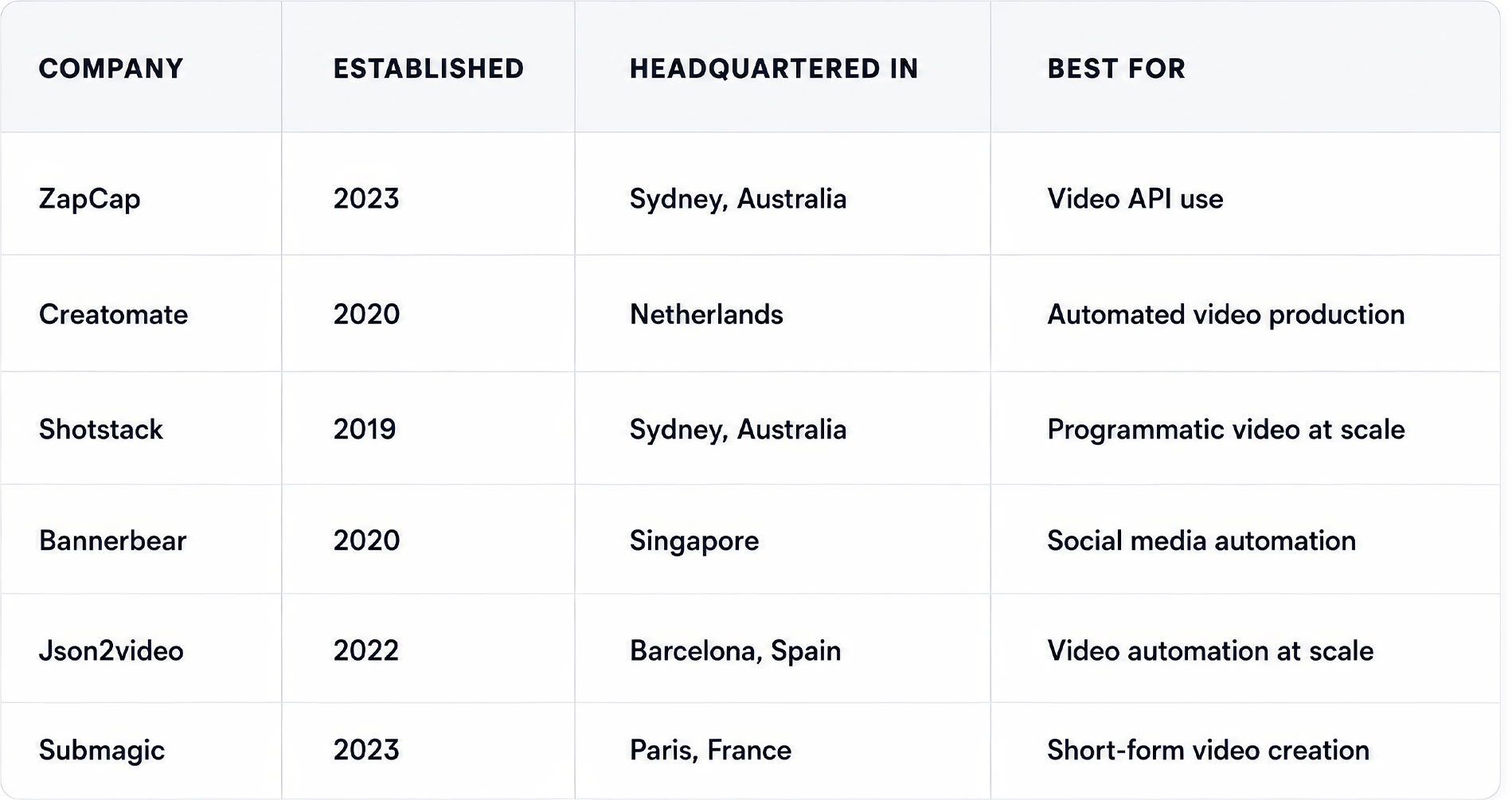
Comparing the 6 Best Video Captioning APIs
Note: All data in this table is sourced from review platforms and the official websites of the listed companies. These are largely self-reported vendor figures and have not been independently verified by SubSub; treat them as vendor claims, not audited metrics.
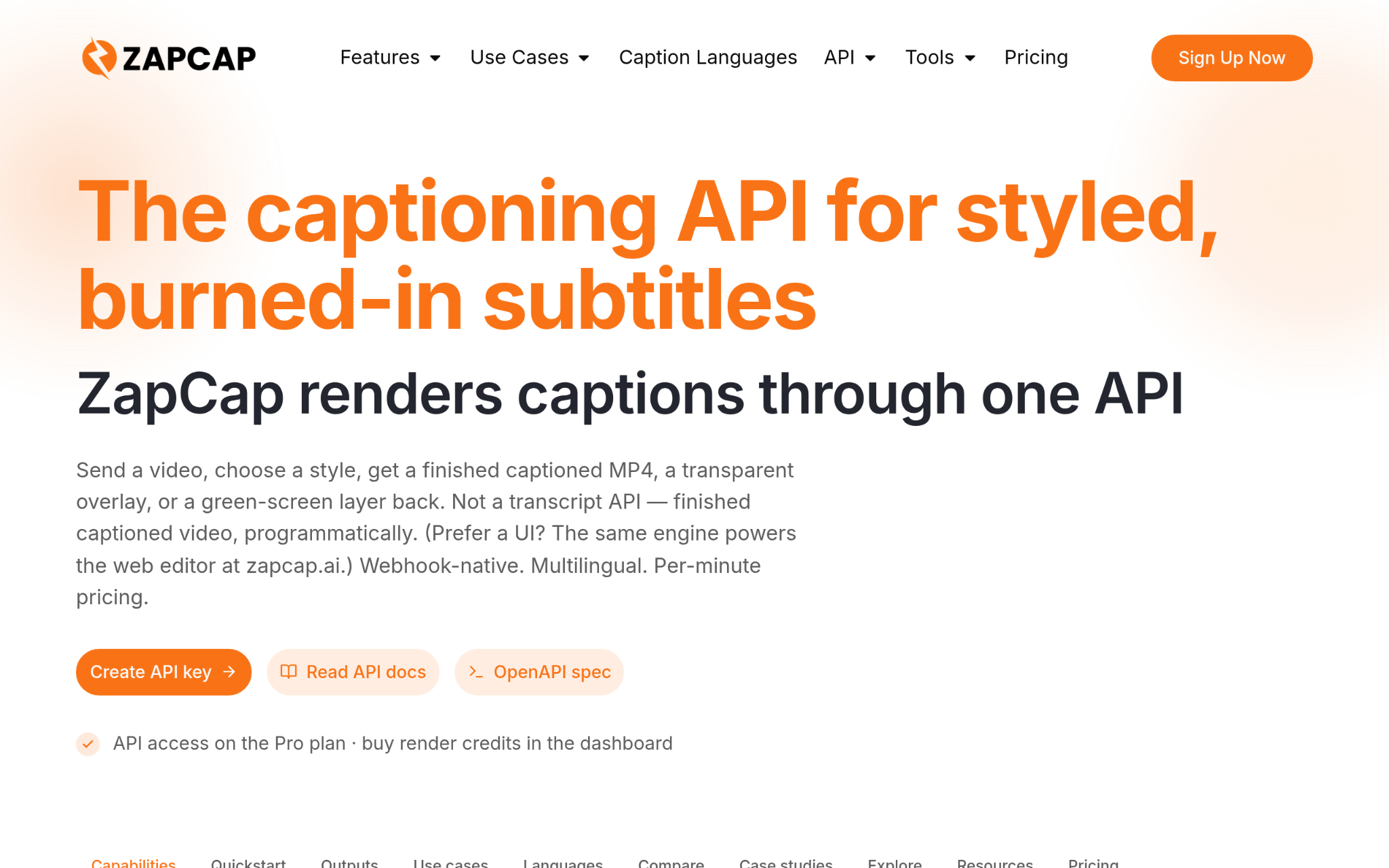
ZapCap sits in an interesting spot in the captioning API space. They handle the full production pipeline, from accurate multilingual transcription in 90+ languages to burned-in, styled subtitles delivered in multiple output formats including MP4, alpha overlay, and green-screen. With over 500K active users and 700,000+ videos generated, they've clearly hit something that works. The $0.10/min pricing is transparent and predictable, which matters a lot when you're budgeting API call volume across a large video library.
What Sets ZapCap Apart for Video Captioning APIs?
Most captioning APIs give you a transcript and expect you to handle rendering yourself. ZapCap delivers production-ready captioned videos directly, which removes an entire layer of post-processing work. That kind of end-to-end output is rare in a per-minute pricing model, and it makes ZapCap genuinely useful for teams that want to ship, not build.
What Users Are Actually Saying:
From what the reviews show, creators trust ZapCap enough that, according to ZapCap, well-known names like Ali Abdaal and Grant Cardone use it, which the company says points to real credibility. The platform reportedly saved over 176,000 creator hours, and that kind of real-world signal is hard to fake. The consistent praise around ease of use and caption accuracy across multiple languages stands out across the community.
Creatomate - Best for Automated Video Production
How Is Creatomate Positioned in the Market?
Creatomate is a video generation API built from the ground up for developers and no-code teams who need to automate video production at volume. Founded in 2020 by a small Dutch team, they offer a REST API, JavaScript Preview SDK, and native connections with Zapier and Make. The browser-based template editor is genuinely useful for teams who want to prototype without writing code first (not always a given with developer-focused tools). Their focus spans social media automation, e-commerce personalization, and advertising use cases.
What Sets Creatomate Apart for Video Captioning APIs?
Creatomate solves the problem of teams needing both developer-grade API access and no-code workflow options within a single platform, without forcing a trade-off between the two. That flexible architecture usually means faster time-to-caption from upload to delivery across very different team setups.
What Users Are Actually Saying:
Users consistently point to Creatomate's customer support as a genuine differentiator, which is worth something when you're a two-person team operating at this level. The API flexibility gets specific praise for making cross-team collaboration cleaner. From what the reviews show, it's the kind of platform that earns loyalty because it just doesn't create unnecessary friction.
Shotstack - Best for Programmatic Video Generation at Scale
How Is Shotstack Positioned in the Market?
Shotstack has carved out a clear niche: API-first, cloud-rendered, built for volume. Founded in Sydney in 2019, they serve 20,000+ businesses across 119 countries, including Spotify and IKEA. Their JSON-based workflow approach makes programmatic video creation feel more like writing configuration files than editing video, and their fully managed rendering infrastructure means you're not spinning up servers to handle processing spikes. The white-label SDK option is a smart addition for teams building embedded video editors.
What Sets Shotstack Apart for Video Captioning APIs?
Shotstack removes the infrastructure burden that typically makes scaling video generation expensive and unpredictable. The fact that Spotify uses it to generate thousands of videos daily is the kind of real-world proof that API availability and reliability claims actually hold up in production.
What Users Are Actually Saying:
Customers across review sources point to Shotstack's rendering performance and the ease of getting started through the API as standout positives. The managed infrastructure piece gets frequent mentions because it genuinely removes a sticking point for smaller teams. And for a bootstrapped company sitting at $770K revenue, the enterprise client roster is impressive.
The "Spotify generates thousands of videos daily" claim comes from Shotstack's own published case study, and the ~$770K revenue figure is a third-party estimate not confirmed by the company. Present both as attributed claims rather than facts.
Bannerbear - Best for Automated Social Media Visuals and E-Commerce Banners
How Is Bannerbear Positioned in the Market?
Bannerbear operates as an API and automation tool focused on automating repetitive marketing content production, including images, social banners, and video assets. Founded in 2020 and headquartered in Singapore, they've bootstrapped to nearly $1M in annual revenue with a lean remote team (not cheap to run, but clearly sustainable). Their official Zapier Partner status and tight Airtable connection make them a natural fit for marketers who already run automation-heavy workflows. The API handles the background work so teams can stop manually producing the same assets over and over.
What Sets Bannerbear Apart for Video Captioning APIs?
Bannerbear targets the gap between marketing automation and content production, the repetitive visual output that most teams still do by hand. That focus on workflow depth over feature breadth tends to produce more reliable outputs when you're processing content at volume.
What Users Are Actually Saying:
Public review data for Bannerbear is limited in volume, but the revenue trajectory and consistent growth signal solid customer retention. The automation-first positioning draws repeat users who build it deep into their production stacks. Teams tend to stay once Bannerbear is part of a workflow, which says something real about reliability.
Json2video - Best for Video Automation at Scale
How Is Json2video Positioned in the Market?
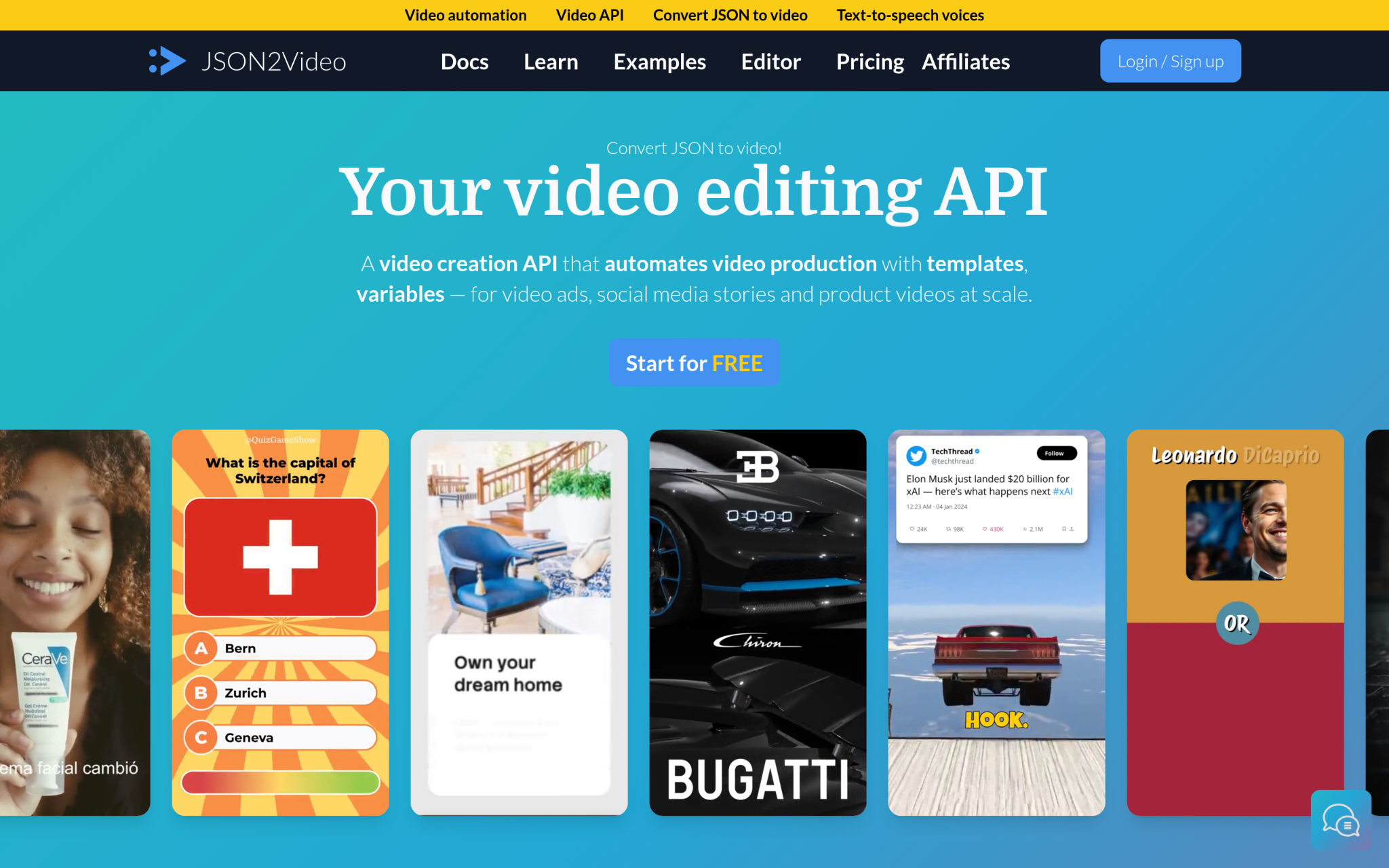
JSON2Video, founded in 2022, runs a full video automation pipeline that handles scene composition, voiceover generation, caption generation, and rendering in one place. With more than 70,000 creators and over 10 million videos generated, the platform has demonstrated its ability to support high-volume video production. It supports real HTML5 and CSS elements with built-in animations, giving designers more creative control than many API-only tools. Use cases span real estate, e-commerce, news publishing, and used car listings, making the platform a versatile option for automated video creation.
What Sets Json2video Apart for Video Captioning APIs?
JSON2Video pulls together captioning, voiceover, and animation into a single render pipeline, which cuts the number of API calls and processing steps needed to produce a finished video. A claimed 99.9% API availability with under two minutes average render time means time-to-caption stays predictable even when processing large batches.
What Users Are Actually Saying:
JSON2Video holds a 4.9/5 rating on Capterra across verified reviews, and the HackerNoon Startup of the Year recognition adds external credibility. Reviewers frequently mention the all-in-one pipeline as the main reason they stayed. For a platform founded just a few years ago, reaching 10M videos is a meaningful achievement.
Submagic - Best for Short-Form Video Creation and Automated Content Repurposing
How Is Submagic Positioned in the Market?
Submagic launched in Paris in 2023 and quickly gained traction. The company grew from $1 million to $8 million in annual recurring revenue within two years without outside funding, demonstrating rapid growth as a bootstrapped business. Its platform focuses on short-form video production with AI captions in 48 languages, automatic editing, B-roll generation, and a Video Editing API for developers. The company also reports serving more than 4 million users, reflecting its broad adoption among creators and video professionals. Its claim of 99% caption accuracy is supported by customer success stories, including a Sportskeeda case study that highlights the production of more than 2,500 videos per month and a 40% increase in reach.
What Sets Submagic Apart for Video Captioning APIs?
Submagic addresses the specific challenge of producing short-form video at high frequency without sacrificing caption accuracy or turnaround speed. That 10x faster editing speed claim starts to feel credible when you look at the output volume their enterprise clients are achieving.
What Users Are Actually Saying:
The growth numbers tell most of the story here. Going from $1M to $8M revenue in two years without external funding shows the product is earning its renewals. Users lean heavily on the caption automation and content repurposing features as the main value. The REST API connection gets specific praise from developer-side users building programmatic workflows.
Methodology Behind These Picks
Gathering Baseline Information
The research started with a broad sweep across developer communities, SaaS review directories, and industry case study libraries. Platforms mentioned repeatedly in discussions around video captioning, subtitle generation, and video production automation were pulled into a working longlist. Official product documentation, landing pages, and API feature breakdowns were collected alongside any publicly available performance claims to build a picture of what each platform actually does.
The Shortlist Cut
From that initial list, platforms without publicly verifiable track records were removed first. Review volume, recency, and consistency across multiple sources were factored in, with special attention paid to patterns in feedback rather than individual ratings. Platforms with scattered or contradictory review signals, or where captioning capabilities couldn't be confirmed through documentation, were cut at this stage.
Fact-Checking the Picks
Each shortlisted platform was checked against its own public claims. Revenue figures, user counts, video output numbers, and performance metrics were cross-referenced with independent sources where possible. Claims that appeared only on a company's own marketing materials without any supporting case study or third-party confirmation were treated with appropriate skepticism.
Authority Signals and Industry Standing
Beyond direct reviews, external signals were examined to assess standing within the developer and media technology community. These included award mentions, coverage in relevant publications, recognition from automation platforms like Zapier and Make, and evidence of developer community trust through third-party connections. Enterprise client mentions, where publicly confirmed, were also treated as meaningful authority signals.
Video Captioning APIs Track Record
Each final pick was assessed for evidence of sustained performance in video captioning contexts. This meant looking for dedicated captioning or subtitle API documentation, verified case studies showing real caption output at scale, and review commentary addressing transcription accuracy and response speed performance. Platforms with only peripheral captioning features didn't make the cut. Most of the companies here have a documented track record in video API functionality, though captioning depth varies by platform.
Picking the Right Video Captioning APIs for You
Choosing a captioning API comes down to more than features. The right fit depends on how your team works, what scale you're operating at, and where accuracy gaps will hurt you most. Here are the important areas worth examining before making a call.
Industry/Domain Experience: Look for platforms with proven output in your specific content category. A captioning API built for social video may handle fast speech differently than one tuned for e-learning or broadcast media. Domain fit reduces the Word Error Rate problems that generic models run into.
Features and Service Options: Beyond transcription, check for burned-in subtitle rendering, multiple export formats, language support breadth, and real-time versus batch processing options. What looks like a full-featured API in marketing often has gaps in the actual feature set.
Pricing Structure: Per-minute pricing models vary widely. Cost per minute of transcribed audio adds up fast across large libraries, so confirm whether pricing scales linearly or includes volume tiers before committing.
Results Measurement: Any credible platform should give you measurable outputs: transcription accuracy scores, caption processing speed benchmarks, and API availability percentages. If a provider can't give you these numbers, that's worth pausing on.
Industry Knowledge and Compliance: If your content touches accessibility mandates such as ADA, CVAA, WCAG 2.1, and FCC closed captioning rules, confirm the API's output format meets those requirements. Not every captioning tool is built with accessibility standards compliance baked in.
The Verdict
The best video captioning API for your stack depends on what you're actually building. ZapCap leads for teams wanting production-ready output with transparent per-minute pricing. Shotstack and Creatomate suit developer-heavy teams building at enterprise volume. Submagic and Json2video cover high-frequency short-form and automation use cases well. As accuracy benchmarks tighten and accessibility mandates expand, demand for reliable captioning APIs will only grow across every content category.