Every creator eventually asks the same question: why does one video take off in recommendations while another, made with the same level of quality, editing, and focus on the same topic, gets 5 views and quietly dies in Analytics? The answer most people look for is a secret recipe - a set of tricks that will “break” the system and make YouTube show a video to everyone.
The platform is designed around the viewer, not the creator - and that is the principle everything else stems from: why short-form videos operate by different rules than long-form content, why a channel with 100,000 subscribers can lose to a channel with 10,000, and why “just post more often” stopped being an effective strategy a long time ago. That is what determines how the YouTube algorithm works in practice, not in theory.
In this article, we’ll look at how the YouTube algorithm works in 2026, what influences recommendations, and which factors help videos get more views. We’ll also cover Shorts, common myths, and practical tips for creators.
What Is the YouTube Algorithm?
The YouTube algorithm helps determine which videos a specific viewer is likely to enjoy. To do this, the platform considers what a person watches, what they skip, and which videos they respond to. For example, if a viewer frequently watches travel videos, YouTube may show them similar content more often. At the same time, different systems operate across different parts of the platform: the Home page, Suggested Videos, Search, and Shorts.
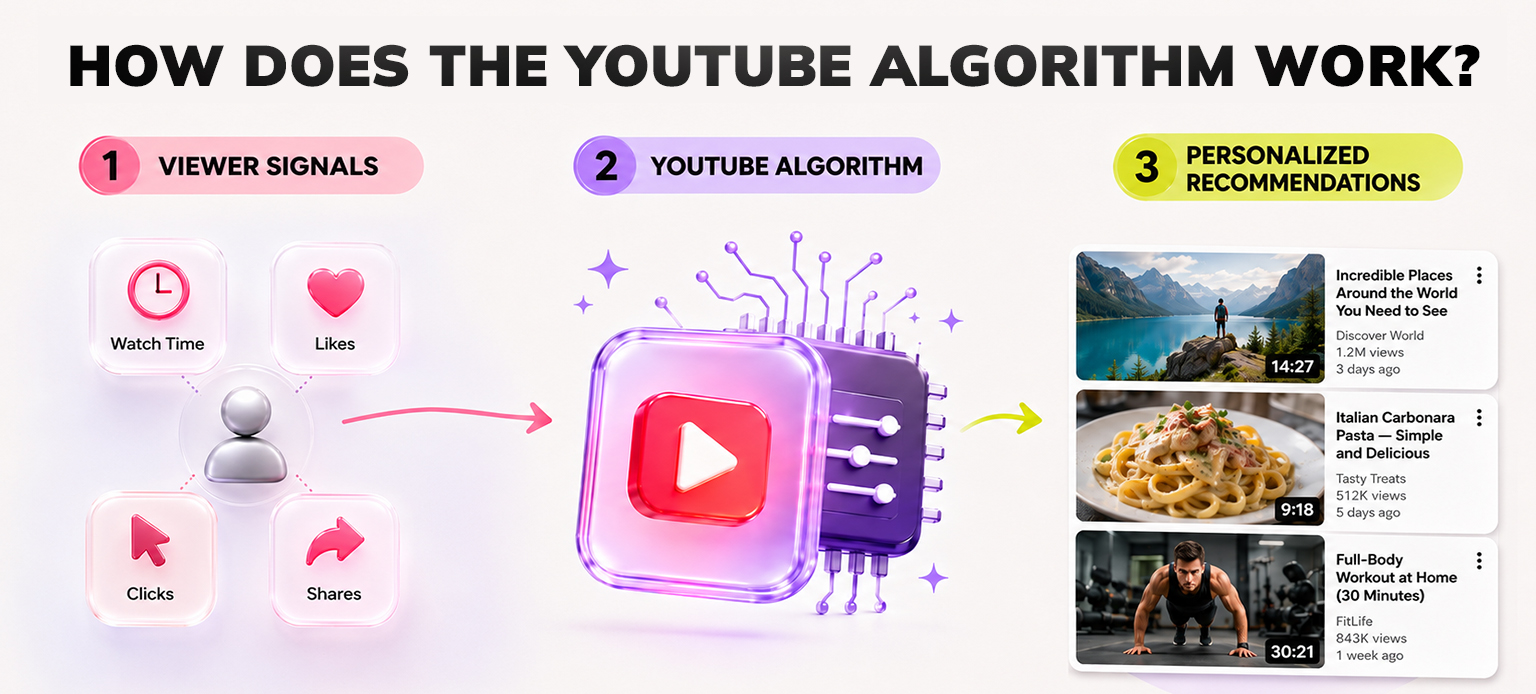
Every day, the system processes more than 80 billion signals - watch and search history, subscriptions, likes, “not interested” clicks, and satisfaction survey responses - and compares your behavior to that of people with similar interests. So, in essence, the algorithm doesn’t rate a video on a fixed scale; instead, it predicts, each time, “will this specific person want to watch this specific video right now?” A single video can get a million impressions with one audience segment and almost none with another, and that’s the system working normally - not the “algorithm curse” that beginners often believe in.
How the YouTube Algorithm Works: Home, Search, Suggested Videos, and Other Sections
To understand how the YouTube algorithm works across different parts of the platform, it’s important to distinguish exactly where a viewer sees a video, because each section responds to its own set of signals.
Home relies mainly on watch history, comparing a person’s habits with the behavior of people who have similar interests. If watch history is turned off and there’s no data, YouTube shows popular and trending content instead of personalized recommendations.
Suggested Videos works differently: the system primarily looks at the video a person is currently watching and offers content that might interest them next.
Search works based on the user’s query. YouTube evaluates how well the title, description, tags, and the content itself match what the viewer is searching for, how deeply people watch the video for that specific query, and how authoritative the source appears to be on the topic.
Subscription feed shows new videos from channels a person is subscribed to, with almost no filtering by interest. The main criterion here is the fact that the viewer is subscribed.
Notifications is the narrowest surface of all: it triggers selectively, depending on whether the viewer has previously engaged with notifications from that specific channel.
Together, these systems form what we call the YouTube algorithm. It’s important to remember that a video that performs well in search won’t necessarily get the same result in recommendations. So it’s worth paying attention to where exactly your viewers are finding your videos.
What the Platform Measures
The platform measures specific signals: whether people click on a video, how long they watch, and whether they come back after watching. These signals make up YouTube’s ranking factors - let’s break down each one.
Click-through rate, or CTR, is the percentage of people who clicked on a video after seeing its thumbnail. For example, if 100 out of 1,000 people click on a video, the CTR is 10%. A high CTR shows that the thumbnail and title caught the viewer’s attention. But that’s not enough on its own: if someone opens a video and leaves almost immediately, it may signal that the content doesn’t match their expectations. Read more about CTR in this article.
Watch time is the total amount of time viewers spend watching your videos. YouTube pays particular attention to this metric: the more time viewers spend on the platform because of your videos, the better it is for the algorithm, so it is important for watch time on the channel to grow consistently.
Audience retention shows how long viewers stay on a video and at which points they leave. If a video is too long or contains uninteresting moments, viewers may close it earlier. For example, a sharp drop at the 30-second mark may indicate a weak introduction or a mismatch between the expectations created by the title and thumbnail and the actual video.
Viewer satisfaction is a separate signal that helps YouTube understand how much viewers enjoyed a video. The platform uses short surveys such as “Did you enjoy this video?” and also considers the viewer’s response after watching - a like or dislike, a comment, and what the person does after watching the video.
Likes, comments, and shares show how interested viewers were in the video and whether it encouraged them to engage. For example, asking a specific question in the video can encourage people to leave a comment, which works better than simply asking them to “like” the video.
Returning viewers and session duration show whether viewers come back to your channel and keep watching other videos after yours. This can positively affect recommendations, even if the viewer didn’t watch your video all the way through.
Upload consistency isn’t about how many videos you post - it’s about keeping a steady schedule. It’s better to publish regularly than to disappear for months and then post a batch of videos all at once.
None of the YouTube ranking factors works independently of the others: a high click-through rate combined with weak audience retention may indicate clickbait and can do more harm than good, while a low CTR with excellent retention and strong engagement often means the problem is not the content but the thumbnail and title.
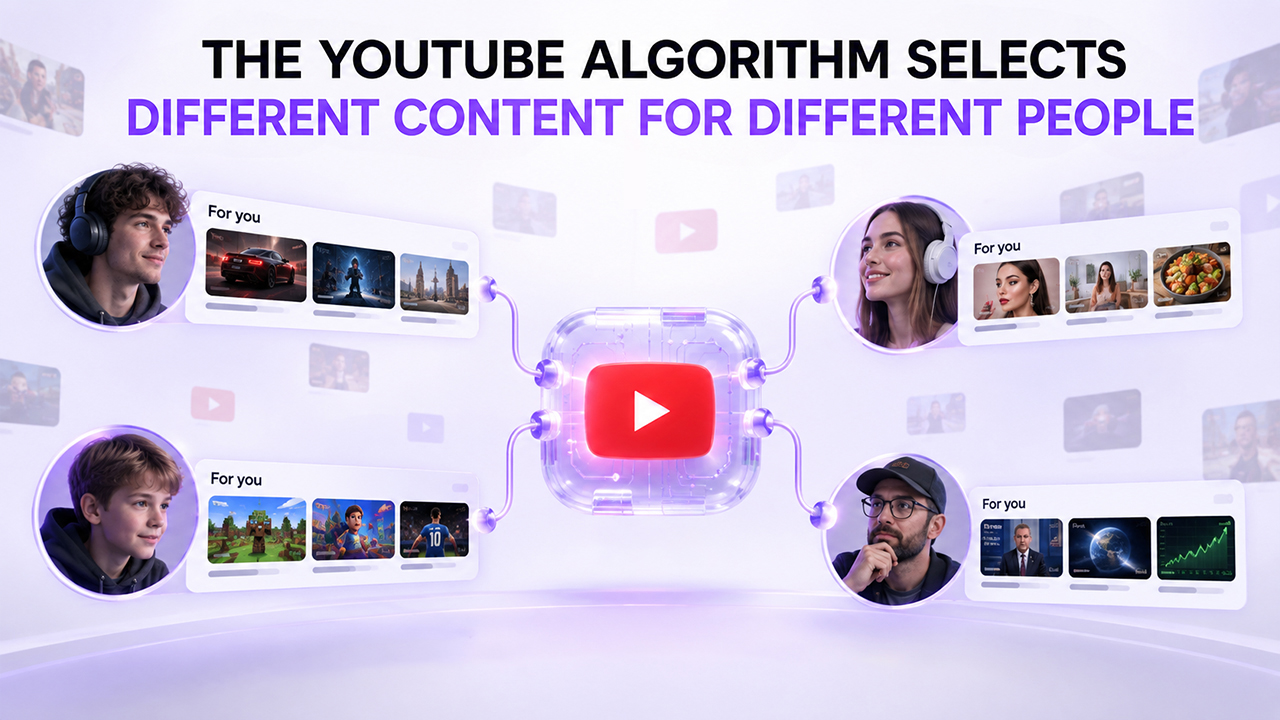
YouTube Recommendation Algorithm: Why Two People See Different Videos
The YouTube recommendation algorithm works simply: the system does not show the best video in a niche to everyone. It shows the video that is most likely to appeal to that specific person at that specific moment.
Imagine two people who are interested in fitness: the first watches short motivational videos and rarely watches anything longer than three minutes, while the second regularly watches detailed 20-30 minute technique breakdowns. Formally, they are both in the same niche, but the system will recommend different content to them because it also considers the formats and level of depth each person is used to.
For creators, this means that a video may initially receive broad reach and later be shown primarily to viewers who are most interested in it.
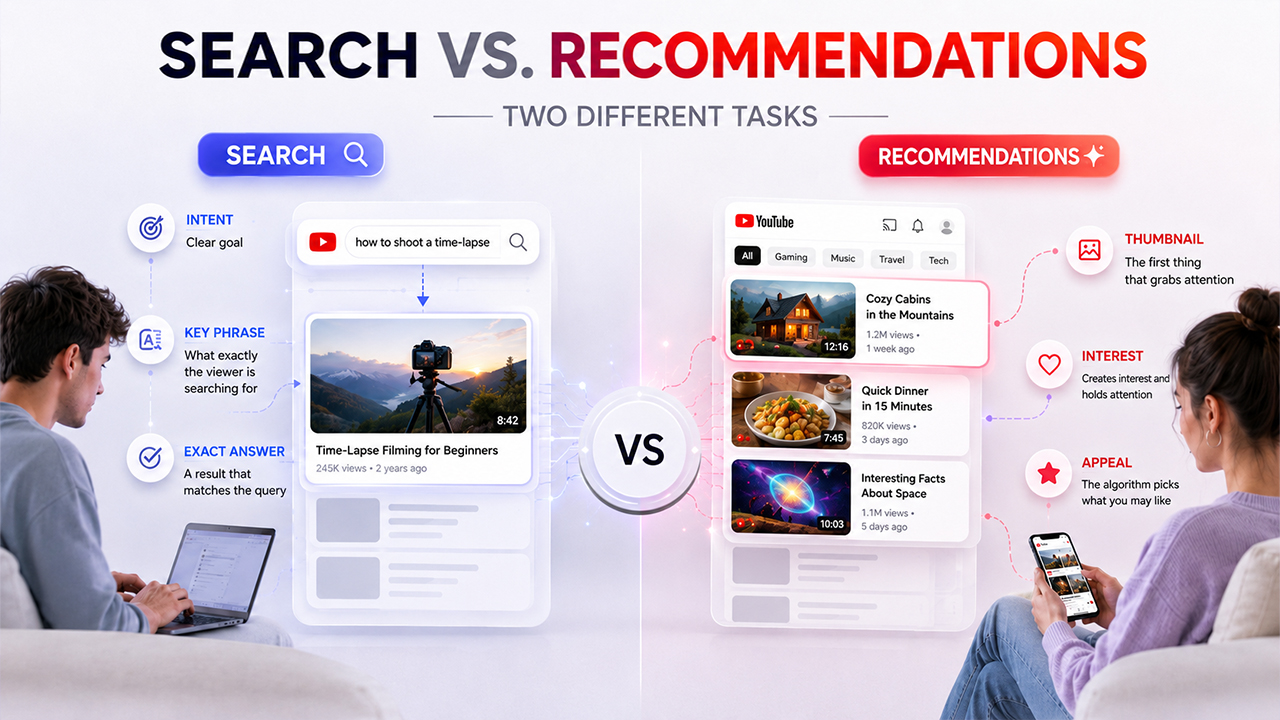
Search vs Recommendations: Two Different Tasks
In Search, a person already has an intent - they are consciously looking for an answer or a solution to a problem. Here, precise relevance wins: topic selection should be based on actual search queries in the niche, the title should contain the key phrase naturally, and keywords in the description should accurately reflect the content. Viewer expectations are specific: a person wants an answer to their question, and if the video does not provide it, this immediately becomes visible in audience retention.
In Recommendations, there is no intent - a person is scrolling through their feed, and YouTube tries to interest them in something they have not even thought about searching for. Here, appeal is what matters: the thumbnail should stand out among neighboring videos, while the title should create curiosity rather than simply describe a fact. Viewer expectations are more flexible here: the main thing is for the video to turn out to be as interesting as it looked in the thumbnail.
Therefore, educational and informational videos are better created with what people are searching for in mind. For entertainment content, it is more important to attract attention with the thumbnail and title in the recommendations feed.
The YouTube Shorts Algorithm in 2026
The YouTube Shorts algorithm is built separately from long-form video - it’s literally a different distribution mechanism, since the usual rules of long-form don’t apply well here.
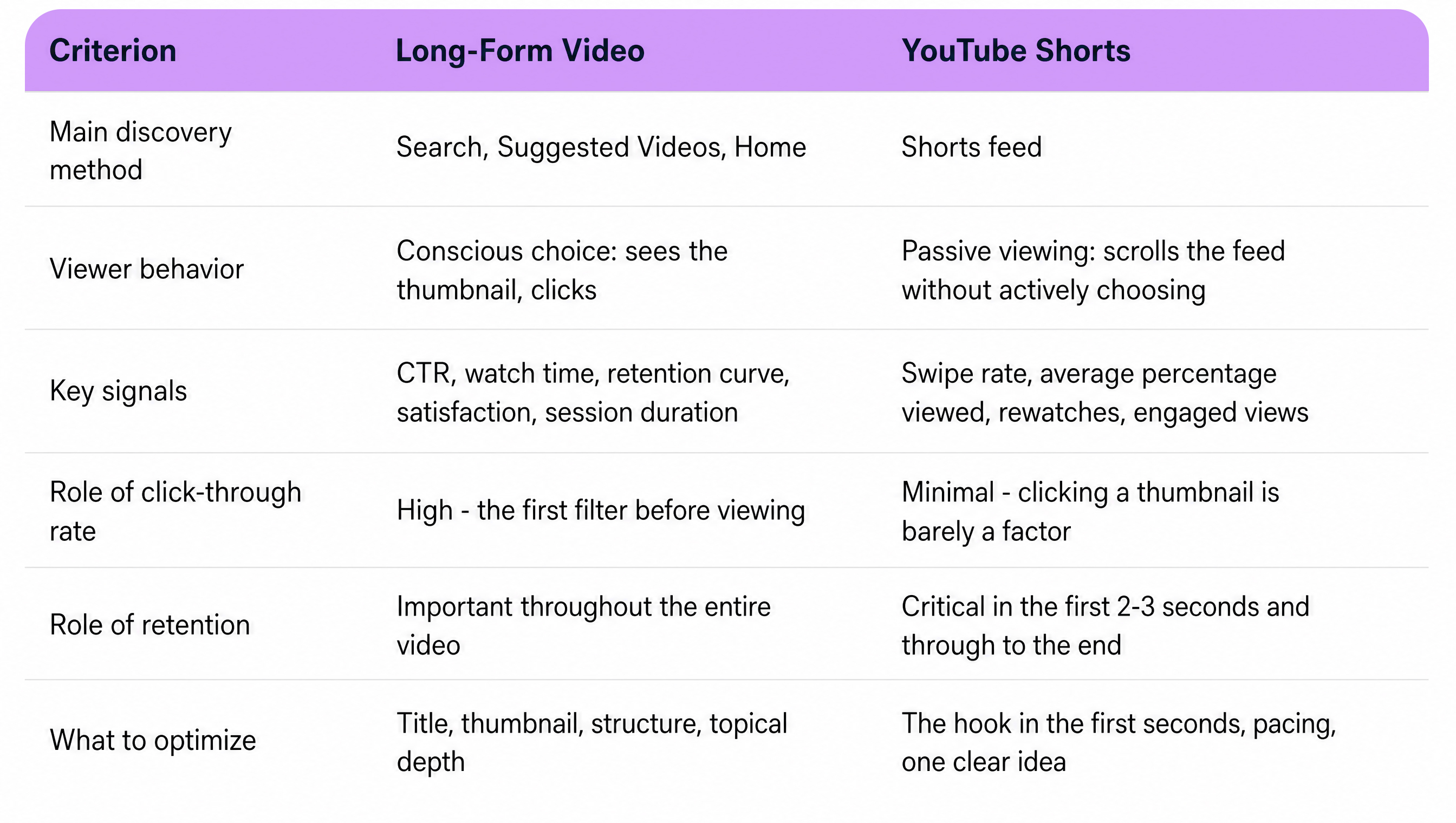
With a long-form video, the viewer makes a conscious choice: they see the thumbnail, read the title, and click. With Shorts, that step barely exists - content plays in a continuous feed, and instead of clicking, people either keep scrolling or stop. So the main signal here is behavior within the Shorts feed itself.
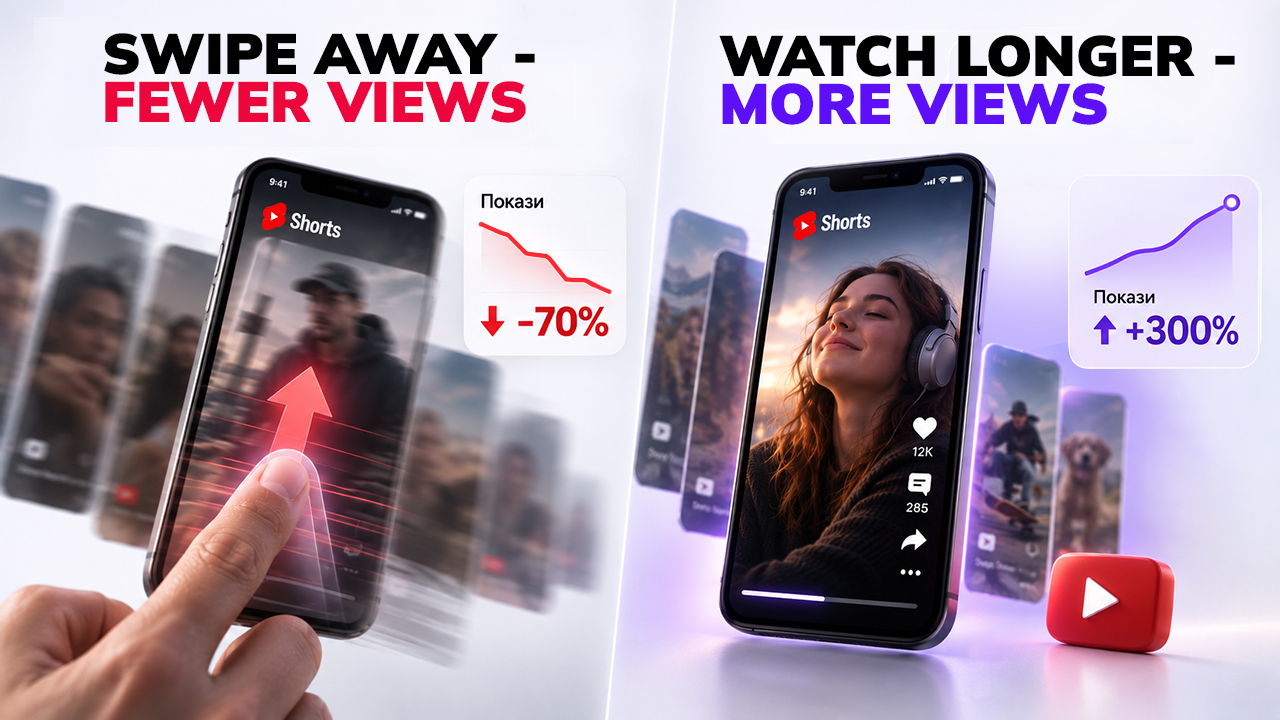
Swipe behavior shows how many people keep watching a Short versus how many swipe away immediately. YouTube first shows a new video to a small group of viewers. If they keep watching, it may get shown to a bigger audience. If most of them swipe away right away, distribution can drop off.
Average percentage viewed shows how much of a Short viewers watch on average. That’s why it’s essential to hook people in the first seconds - a long introduction without getting to the point may make them swipe away
Rewatches are not shown separately in Analytics. But if the average percentage viewed is above 100%, that is what they represent: some viewers watch the Short again, and for the algorithm, this is a sign that the content performed well with viewers.
Engagement covers the likes, comments, and subscriptions viewers make while watching. It shows how much a video interested the audience and prompted them to interact.
Subscriptions from Shorts work differently than on long-form: people often subscribe straight from the feed without having watched a single long video. That’s why Shorts often bring new viewers to a channel in the first place.
How the YouTube Shorts Algorithm in 2026 Differs from Long-Form Content
The main difference is the source of traffic. Long-form videos get views from recommendations, Search, and the Home page, where viewers choose what to watch by clicking on a thumbnail. Shorts mostly get views from the feed, where the system itself initially tests content in waves. At the same time, Shorts can also appear in Search. If you are targeting search queries, the thumbnail and title matter again because videos are selected there in the same way as long-form content. In the feed, however, the thumbnail has much less influence - what matters more is what happens in the first few seconds of the video itself.
Biggest YouTube Algorithm Myths in 2026
Myth 1. The algorithm hates small channels. There’s no evidence that YouTube limits a video’s reach simply because of channel size. Every video is evaluated based on viewer reaction and other signals.
Myth 2. You need to publish videos every day. Frequency alone guarantees nothing. The system responds to consistency and to whether a video meets audience expectations - daily low-quality videos hurt retention more than they help.
Myth 3. More subscribers = more views. For many popular channels, subscribers account for no more than 20-30% of views; most traffic comes from suggested videos, search, and Shorts. A subscription is trust, not a lever that automatically boosts a video in recommendations.
Myth 4. Keywords alone guarantee high rankings. Keywords help YouTube understand what a video is about, but that’s not enough for strong rankings on their own. Viewer reaction and content quality matter too. So a video with well-chosen keywords won’t necessarily outperform one with less SEO optimization but stronger content.
Myth 5. Deleting a video “resets” the algorithm. There’s no official confirmation of any such mechanism. The video simply disappears along with its signals, and it doesn’t affect the channel’s overall status.
Myth 6. One underperforming video “breaks” the channel. An underperforming video doesn’t mean the next ones will do worse. YouTube evaluates every new video separately, based on viewer reaction.
Long-Form Videos vs. Shorts: Comparison Table
The Future of the YouTube Algorithm: What Comes Next
The YouTube algorithm in 2026 continues to evolve. The platform is improving its recommendation systems to better understand viewers’ interests and match them with relevant content. Therefore, one viral video is not enough for sustainable channel growth - it is important to consistently create quality content that interests your audience. It is easier to see what actually works on a channel in real numbers than to guess. In SubSub Analytics you can track key metrics and understand what needs to be improved.
Viewer satisfaction is becoming more important than watch time itself. YouTube is increasingly focused on whether a video was genuinely enjoyable and useful, rather than simply on its length. Recommendation personalization is also becoming more precise. Therefore, a channel with a clear topic may be better at finding its audience than a channel that publishes content about “a little bit of everything”. Trust in the creator also remains important, especially for news, medical, and financial videos. In these areas, YouTube pays more attention to the quality and reliability of information.
There is another trend: viewers may lose interest more quickly in content that looks completely generated - with synthetic voices, avatars, and scripts without the creator’s personal style. This is not an official ranking factor, but such audience reactions can affect retention and viewer satisfaction.
Metadata - titles, descriptions, keywords, and chapters - also remain important, especially for educational content and search queries. Most likely, YouTube will continue developing personalization and placing more emphasis on content quality rather than on any single metric.
Conclusion
If you had to sum up the entire YouTube algorithm in one sentence: the system is constantly trying to guess what a specific person will want to watch - and what will leave them satisfied afterward. There’s no switch that suddenly “unlocks” recommendations for a channel, and no hidden penalty that shuts them off for good - just a constant match between what your title and thumbnail promise and what the viewer actually gets from watching.
FAQ
How does the YouTube algorithm work? YouTube uses several recommendation systems that analyze behavioral signals - watch history, search history, subscriptions, and reactions - to match each viewer with the video most likely to be watched and enjoyed.
What is the YouTube recommendation algorithm? It’s a system that selects videos for each viewer based on their interests and behavior. It shapes recommendations on the homepage, in the Up Next panel, and in other sections of YouTube.
Does watch time matter more than CTR? They’re different stages of the same process: click-through rate (CTR) determines whether a video gets watched at all, while watch time and audience retention determine whether it keeps getting recommended afterward.
How does the YouTube Shorts algorithm work? A new video is first shown to a portion of viewers. If they watch it through, don’t swipe away, or rewatch it, YouTube may show it to more people. The most important signals are views, swipes, watch duration, and rewatches.
Does uploading more often improve rankings? Frequency alone guarantees nothing - what matters more is a consistent rhythm and whether each video meets audience expectations.
How does YouTube decide what to recommend? The system compares a viewer’s watch and search history with the behavior of similar users, and factors in direct satisfaction signals - likes, dislikes, surveys, and “not interested” clicks.
Can new channels grow through the YouTube algorithm? Yes - every video is evaluated on its own signals, not the size of the channel. That means new channels can get recommended too and attract new viewers.
How important is audience retention? It’s one of the most sensitive YouTube ranking factors: it shows the dynamics of exactly where viewers lose interest, not just whether they watched.
What changed in the YouTube algorithm in 2026? The role of viewer satisfaction has increased, personalization has become more precise, and recommendations are placing more emphasis on the interests and behavior of individual users.