Creators have started receiving notifications in YouTube Studio stating, “Your channel isn't earning right now,” with the reason listed as Unsatisfying or off-putting content. This is not a separate new ban introduced by the platform, but one of three subcategories under the updated Inauthentic Content policy, which YouTube detailed in July 2026. In other words, it is a continuation of the same approach that led to the widespread demonetization of inauthentic content six months ago.
In its notification, YouTube quotes the definition verbatim: “Content that may be emotionally manipulative, disturbing, nonsensical, shocking, or otherwise similarly unsatisfying to viewers without delivering significant creative, educational, or other value.”
Key note: Unpaid earnings may be withheld in accordance with the YouTube Partner Program terms.
How This Connects to the Previous Inauthentic Content Enforcement
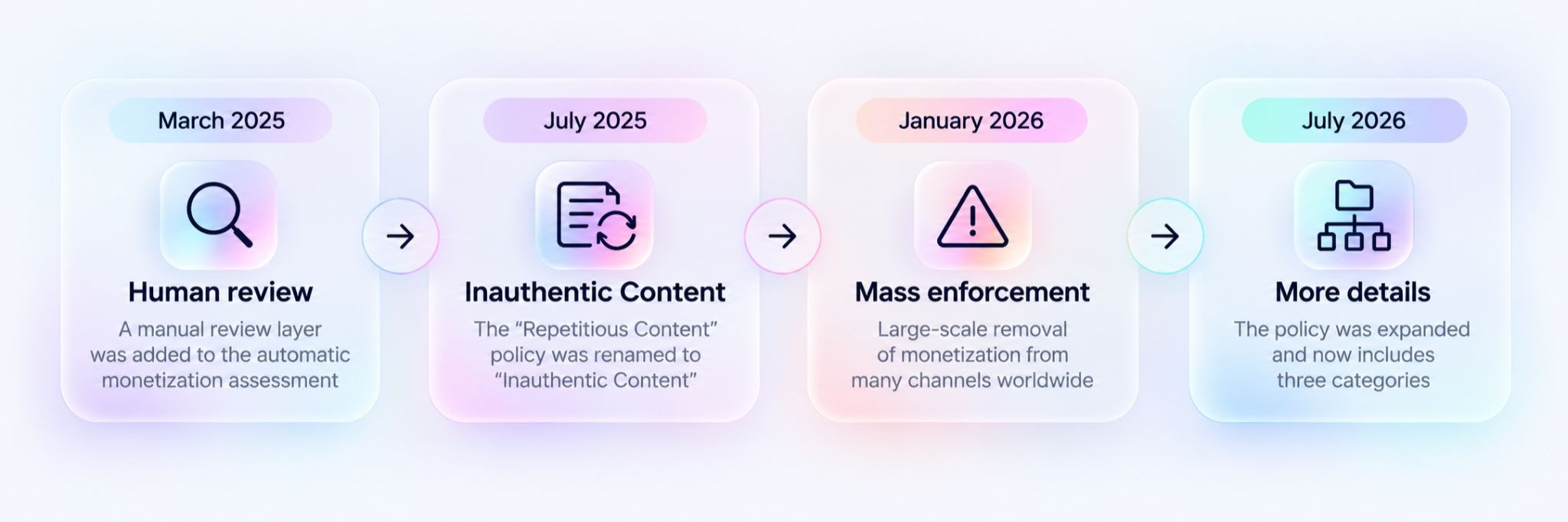
To understand what is happening now, it is useful to look at the sequence of YouTube's policy and enforcement changes:
March 2025 - YouTube added a human review layer to its automated ad-suitability assessment. Since then, monetization decisions may be reviewed by a person and can take up to 24 hours
July 2025 - The “Repetitious Content” policy was renamed “Inauthentic Content” to more clearly cover mass-produced and template-based content
January 2026 - YouTube launched a large-scale enforcement campaign targeting inauthentic content, removing monetization from many channels worldwide. A high-profile example was the animation channel CuentosFacinantes, with around 6 million subscribers
July 2026 - YouTube further detailed the policy by dividing it into three categories, including “Unsatisfying or Off-putting Content
At the time, in January, the focus was essentially on identifying signs of a content production pipeline: whether content looked “template-made” and interchangeable; synthetic voiceovers without original commentary; templated thumbnails and recurring storylines with minimal variation; slideshows with identical narration; upload frequency inconsistent with a manual editorial process; and translations or copies of existing content without substantial transformation. The current stage shifts the focus from mass production and repetition toward the emotional quality and value of a video for the viewer. If six months ago the question was, “Is this unique, or is it mass-produced?”, the additional question now is, “Is this manipulative, shocking, or ultimately empty for the viewer?”
Official Description: The Three Categories of Inauthentic Content
Generic or Repetitive Content. According to YouTube, this refers to content “that looks like it was made from a template or that may feel repetitive to viewers after watching several videos in a row.” Examples include: low educational value and minimal variation; videos that repeatedly place characters in the same situation with the same outcome; slideshows and templated storylines; AI-generated content built around generic templates that creates the impression of mass production
Unsatisfying or Off-Putting Content - this is the category currently appearing in the latest demonetization notices. It is discussed in more detail below
AI Personas Related to Sensitive Topics. This includes content that presents itself as “a human expert giving advice on topics such as health, law, finance, or politics”: AI “doctors” promoting health remedies, AI “podcast hosts” giving financial advice, or AI “lawyers” providing legal guidance
What Counts as “Shocking” or “Off-Putting” Content
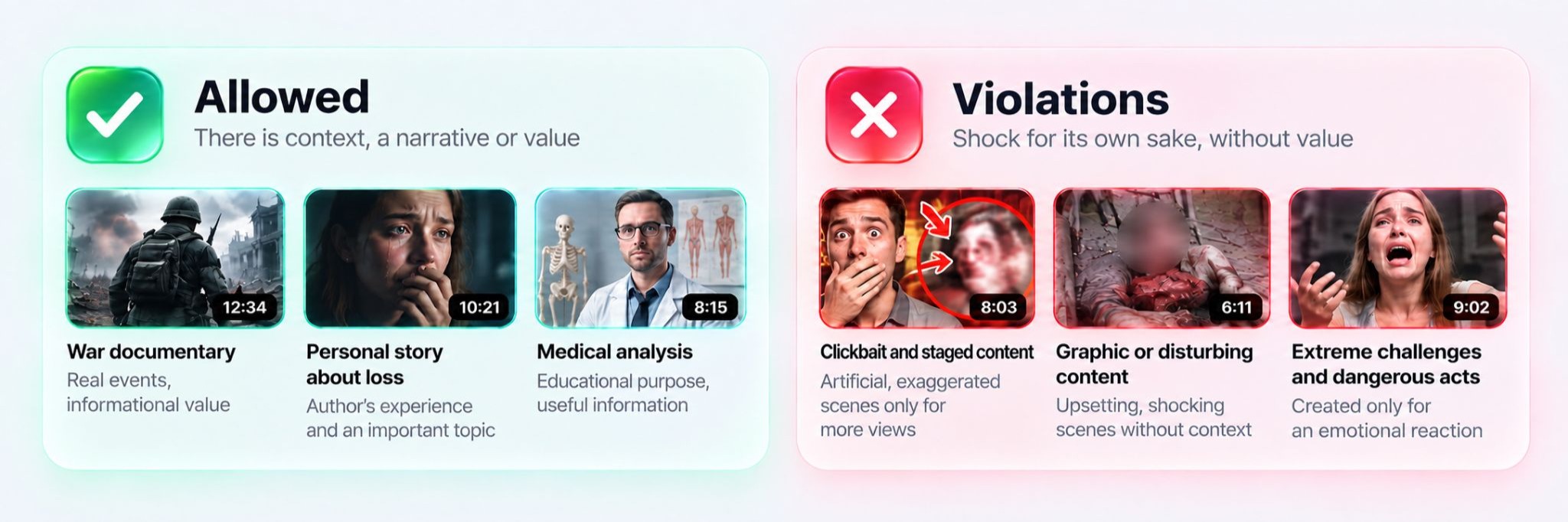
YouTube's official definition describes this category as content that “heavily relies on emotionally manipulative formulas, imitates existing formats or stories to such an extent that videos become interchangeable, or appears to be created to shock or surprise viewers solely for the purpose of generating views.”
The key phrase here is “solely for the purpose of generating views.” Shock itself is not necessarily the problem. The issue is when shock becomes the end goal, without a meaningful narrative or value for the viewer. Violence in a documentary about war, a difficult topic such as loss in an original film, or a medical analysis are not automatically violations. The problem arises when negative emotion becomes the only “engine” driving the video.
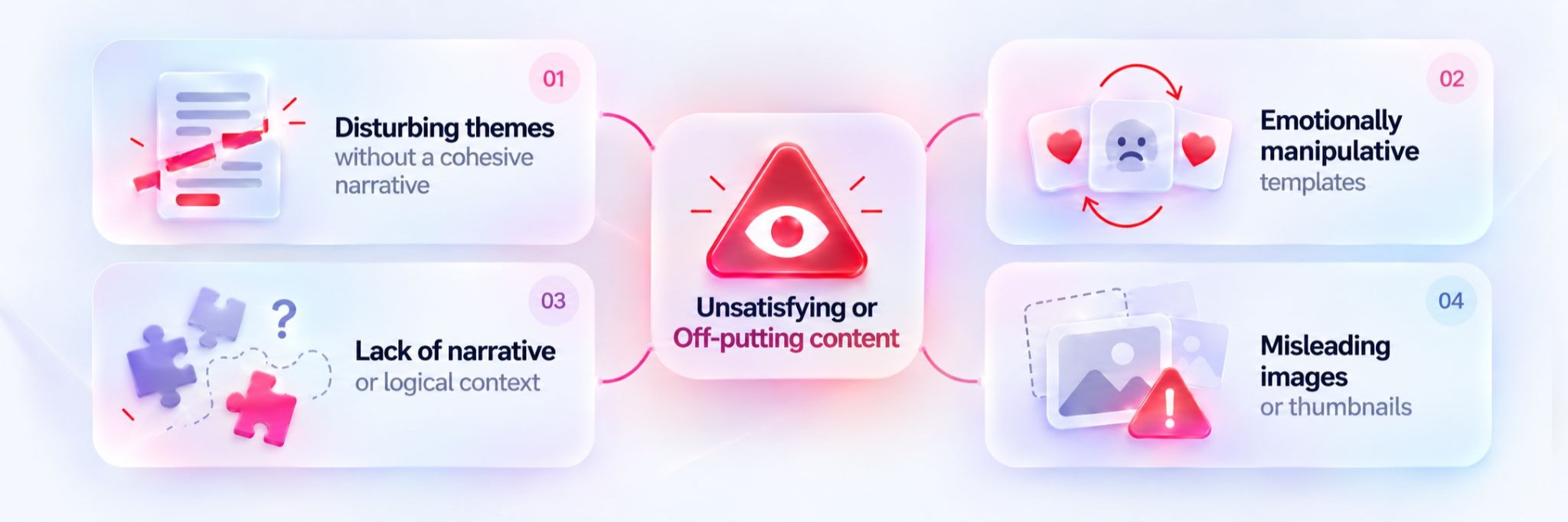
YouTube provides four official examples of this type of content:
Disturbing topics without a coherent narrative - videos that repeatedly exploit violence or loss without building a coherent story or leading the viewer toward any meaningful conclusion
Emotionally manipulative templates - including recurring formats in which animals are shown in exaggerated danger or suffering. A classic example is the staged “animal in distress and its rescue” format
Lack of narrative or logic - videos stitched together from unrelated or inconsistent AI-generated clips simply to surprise or shock the viewer. For example, AI-generated stories about “helping” homeless, poor, or sick people, where scenes are strung together without a coherent storyline and exist primarily to provoke an emotional reaction and generate views
Misleading visuals or storylines - realistic visuals that mislead viewers into believing that a fake celebrity death or natural disaster actually occurred
In practice, the same logic can also apply to similar techniques: shock-bait in thumbnails and titles (“something terrible just happened”) that is not actually present in the video; unjustified suffering of people or animals used as a hook; artificially intensifying pity, fear, or disgust according to the same formula from one video to the next; as well as content that is generally off-putting in its presentation, creates discomfort, and provides no meaningful value to the viewer - essentially leaving them with a sense that they have wasted their time.
It is important to understand that this is a subjective, “taste-based” standard. A moderator is not necessarily assessing whether a specific rule was violated, but rather the overall impression of the content - whether the video feels manipulative. As a result, these decisions can be more difficult to appeal, and legitimate creators may also be affected - particularly faceless channels, which automated detection systems may struggle to distinguish from automated content farms with similar publishing patterns.
What Creators Should Do: A Practical Checklist
Audit your own content - look at your channel through a moderator's eyes. Review your latest videos and thumbnails and identify repetitive, template-based, or “shock” content that provides little value. Rework or remove it before your channel is reviewed by YouTube
Add value to every video - include a human element: your own voiceover, personal experience or perspective, unique examples, analysis, or a conclusion. Ask yourself: “Why should someone watch this on my channel?” The answer should be evident in the video itself
Remove “shock for the sake of shock” - avoid fake deaths, disasters, staged suffering, or misleading thumbnails used purely as hooks
Avoid templates - each video should offer something meaningfully different from the previous ones
Build a coherent narrative, especially with AI content - maintain a logical sequence instead of assembling clips simply for a “wow” effect
Be careful with AI personas covering sensitive topics - health, finance, law, and politics presented through an “AI expert” persona are high-risk areas
Disclose AI use - enable the “AI use” disclosure in YouTube Studio for photorealistic synthetic content
What to Do in the First 48 Hours After Demonetization
Do not delete or hide videos before submitting your appeal. This does not speed up the review process and can remove evidence that may support your case
Document where the value in your content comes from: who writes the scripts, who provides the voiceover, where the source material comes from, and what you add yourself
Record a video appeal. Focus on your production process and originality rather than saying that “the channel has been around for a long time” or that “the algorithm made a mistake”
Submit the appeal through YouTube Studio and wait for the review
If you have a partner manager, consider sending them the case as well
If you run into difficulties or would like us to analyze your channel before it is reviewed by YouTube, contact us at creators@subsub.cc or @subsub_admin on Telegram