You see a video's CTR fall from 9% to 4%, so you go swap out the thumbnail. Chances are you were about to fix something that isn't broken. The percentage dropped because YouTube pushed the video out to a wider audience, which means it's pulling more views now, not fewer.
CTR is one of those metrics you almost can't read on its own. The number tells you nothing until you put it next to impressions, traffic source, and retention.
This guide covers what counts as a good CTR for YouTube videos, how to read your number alongside retention, why the percentage slips on videos that are actually growing, and how to earn more clicks without leaning on misleading clickbait.
What is YouTube CTR?
CTR (click-through rate) shows what share of people opened your video after seeing the thumbnail.
CTR = views from impressions ÷ impressions × 100%
If your thumbnail was shown 10,000 times and the video was opened 600 times, your CTR is 6%. Six out of every 100 impressions turned into a view.
Which impressions count
YouTube doesn't count every time your thumbnail lands on a screen. Per YouTube's own rules, an impression only registers when the thumbnail was at least half visible for longer than one second. Separately, there's traffic that brings in views but never counts as an impression at all:
☐ thumbnails on external sites and in embedded players ☐ links shared through messengers, chats, and social feeds ☐ end screens and certain in-player elements ☐ notifications about new uploads
So the CTR you see in YouTube Studio describes a slice of your traffic, not the whole thing.
That's also why dividing all your views by all your impressions won't reproduce the exact figure Studio reports. Studio only counts views that started from a counted impression. And when a lot of traffic arrives from outside YouTube, you can end up with more views than impressions. For a full breakdown of which views YouTube counts and why the numbers in your analytics don't always line up, see our separate guide.
Why CTR matters
Before the click, a viewer has five things to go on: your thumbnail, the title, the channel name, the duration, and the view count. CTR measures how well that packaging convinces someone to open the video.
The click is only step one, though. If people leave a few seconds in, a high CTR won't save you. Recommendations also run on retention, watch time, and viewer satisfaction.
The platform keeps serving videos that convert the impressions they've been given, and it gradually stops serving the ones that don't — often before the algorithm has formed any opinion about the content itself.
The cleanest way to think about it: CTR gets people in the door, retention decides whether they stay.
What is a good CTR on YouTube?
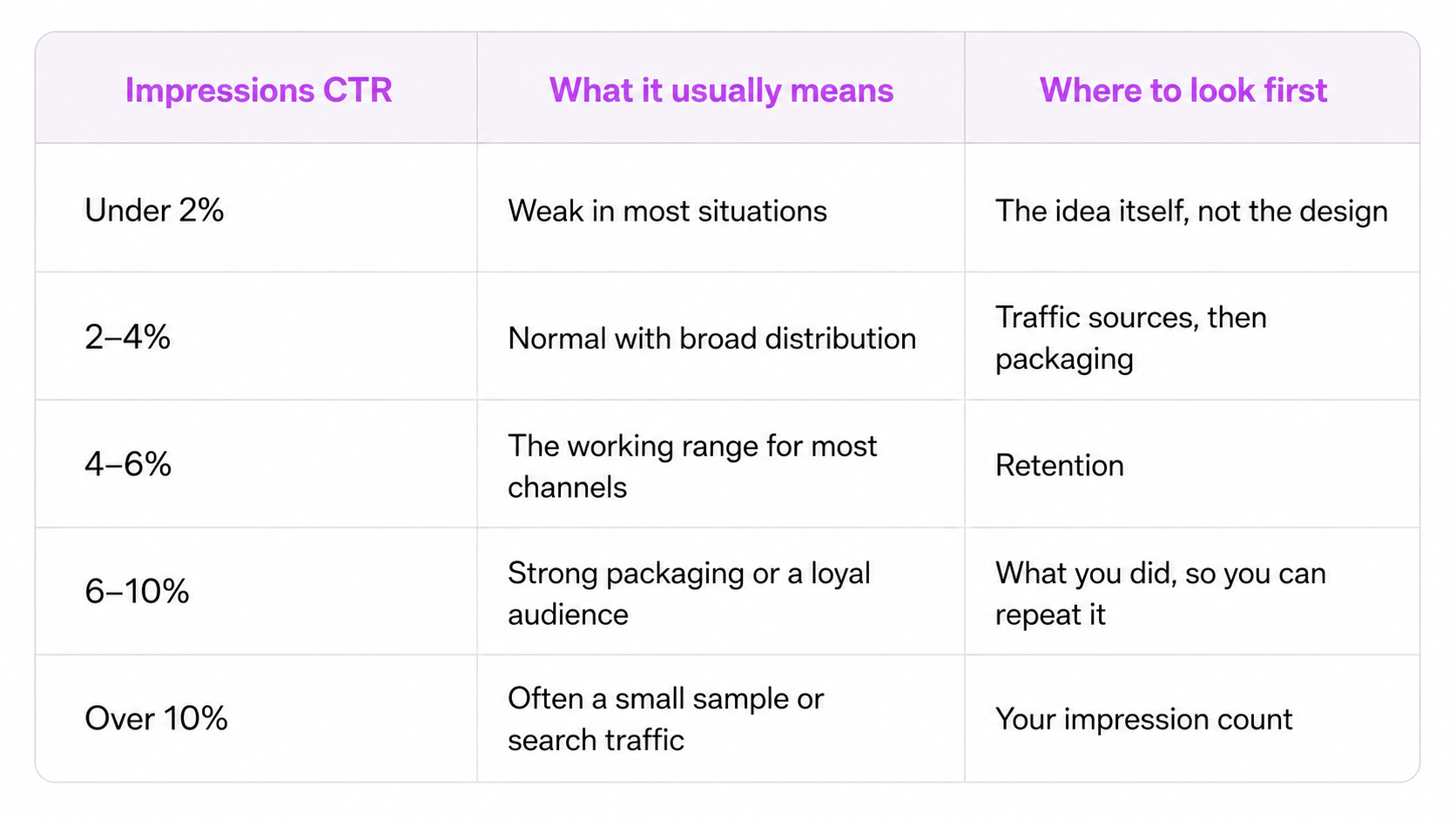
YouTube says half of all channels and videos sit somewhere between 2% and 10%. For most channels, 4–6% is a working level. But there is no fixed "correct" figure. A 3% rate across huge reach can deliver far more than 10% on a tiny sample.
The range is wide, so here's how to place your own number inside it.
A good CTR is whatever number brings in enough views and enough viewers who stay. Measuring yourself against another creator is a waste of time, because they have a different share of subscribers in the mix, a different niche, and a different traffic split.
Niche shifts the baseline too. Search-driven categories like tutorials, software walkthroughs, and how-to content tend to sit higher, since the viewer already typed the thing they want. Entertainment, vlogs, and gaming lean more on home page and suggested traffic, where reach is broader and the percentage naturally lands lower. Evergreen videos behave differently from trending ones as well: a video that stays relevant for years keeps accumulating cold impressions long after the launch spike is over.
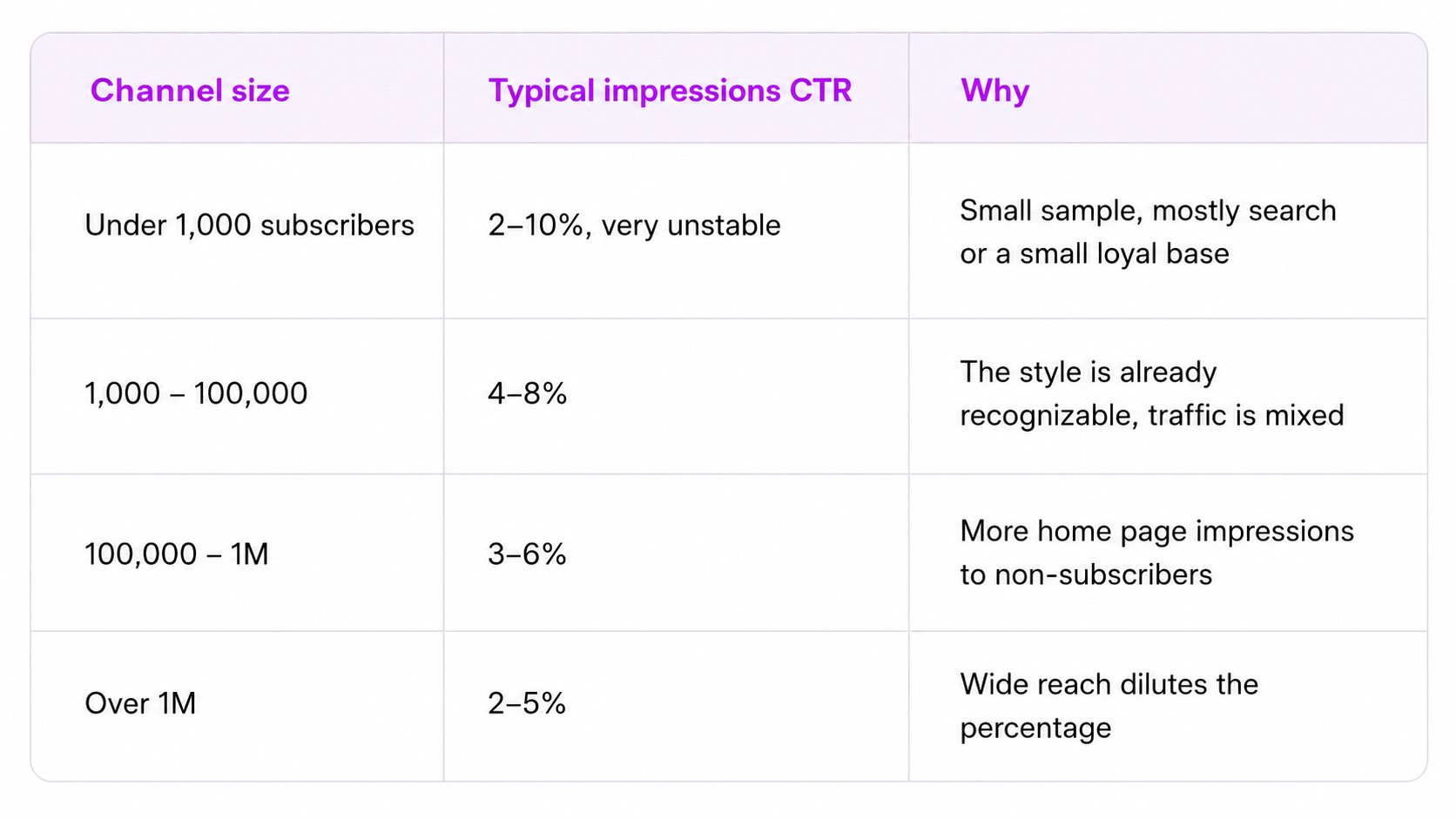
Average YouTube CTR benchmarks
YouTube CTR tends to slide as a channel grows, and that usually catches people off guard. Videos on big channels get shown to strangers far more often, and strangers click less.
Why CTR falls when impressions climb
In the first hours after publishing, YouTube usually shows a video to the people most likely to want it: subscribers, regulars, and viewers who've watched something similar. As the video earns more impressions, it moves out to a colder audience, where plenty of people don't know you and care less about the topic.
20,000 impressions × 9% = 1,800 views
500,000 impressions × 4% = 20,000 views
So a falling percentage on a video that keeps growing usually means it's working. YouTube states this outright: with a large volume of impressions, a lower CTR is normal. The same holds over time. On videos that stay relevant for years, the number settles as search and suggested impressions pile up.
CTR by traffic source and format
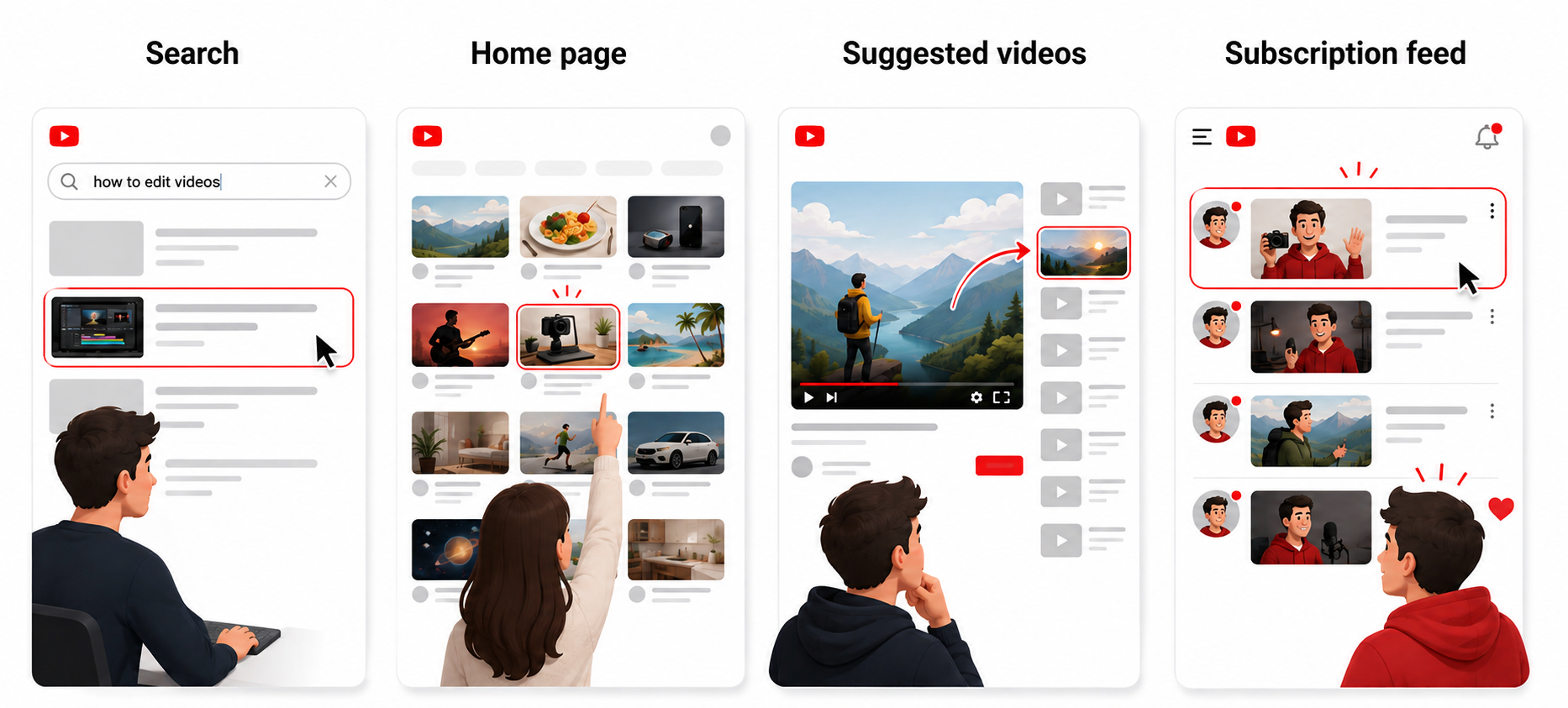
YouTube splits CTR by traffic source, and that's worth checking before you judge the number at all. The average YouTube thumbnail CTR in search has almost nothing in common with what passes for normal on the home page.
Search. The viewer has already decided what they need, so specific titles that match the query win. YouTube CTR from search is usually the highest of any source.
Home page. Nobody here is looking for anything in particular. The viewer is choosing among dozens of unrelated recommendations. Clear ideas and thumbnails that read at a small size do best. Reach is broad, so the percentage from this source runs lower.
Suggested videos. What matters is the connection to whatever the viewer is watching right now. A great thumbnail on an unrelated topic will lose to a plain one that continues the thought of the current video.
Subscription feed. Regulars already know you, and that recognition lifts the number. A video that got most of its impressions from subscribers can't be compared to one YouTube pushed hard to a new audience.
Shorts. Classic CTR barely applies, since Shorts autoplay. The first few seconds, viewed percentage, and rewatches matter far more.
Long-form. The viewer is deciding whether to hand you fifteen minutes. The packaging has to justify that time, not just describe the contents.
How YouTube thumbnails affect CTR
A thumbnail gets a fraction of a second to stop someone's eye. In a mobile feed it's small, so busy compositions and fine print disappear. That's exactly why most of the advice below is about what to take out.
Four things move the needle most: contrast, curiosity, emotion, and readability.
Contrast keeps your thumbnail from blending into everything around it.
Curiosity is what triggers the click, but the video has to actually answer the question you raised.
Emotion on a face lands faster than text. The brain reads it almost instantly.
Readability means the thumbnail makes sense even when it's tiny. If someone has to enlarge it to work out what's going on, it's already failed. Most people see previews on a phone, so design for the small screen first.
A consistent visual style helps regulars spot your videos faster while scrolling. There's no universal "correct" average YouTube CTR for thumbnails, so treat the checklist below as a self-audit instead of a target.
Thumbnail checklist
☐ Main subject (or subjects) in the foreground ☐ Reads at phone-thumbnail size (shrink it to 20% and check) ☐ No more than 3–5 words of text ☐ Sharp contrast between subject and background ☐ A visible emotion, problem, or result ☐ Complements the title instead of repeating it ☐ A promise the video actually keeps ☐ Technical specs: 1280×720, 16:9, under 2 MB
Titles that increase CTR
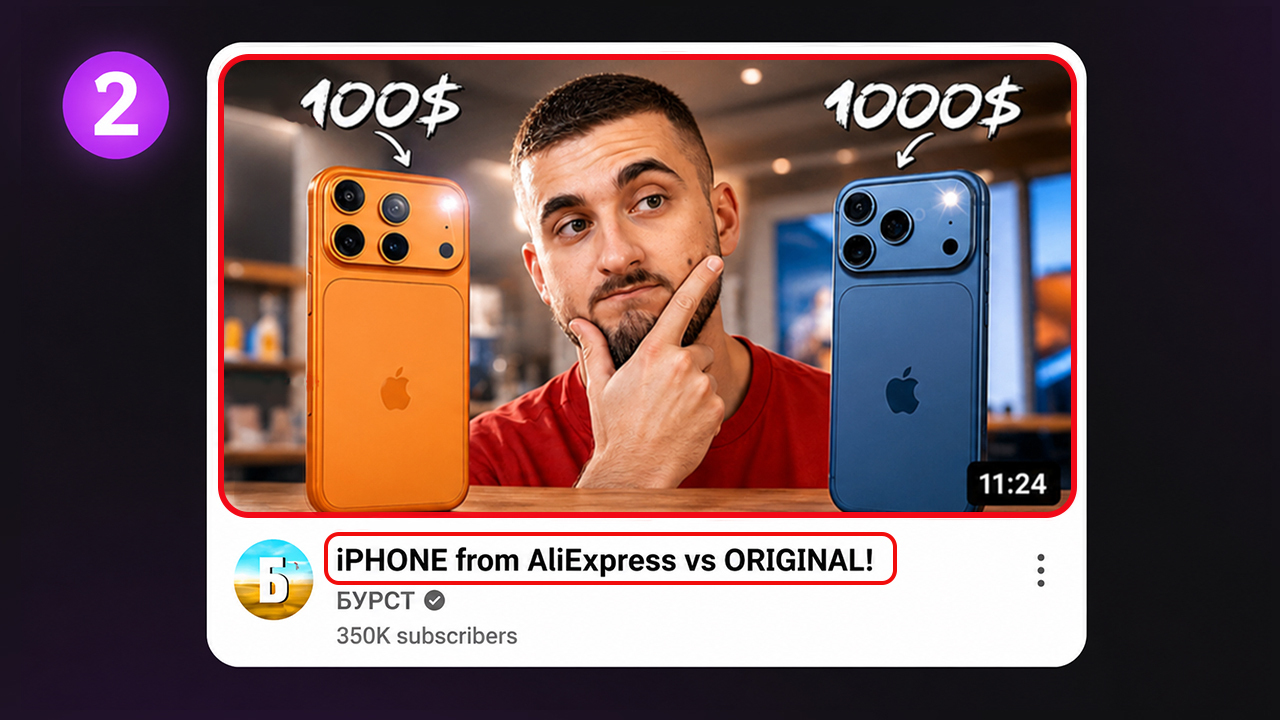
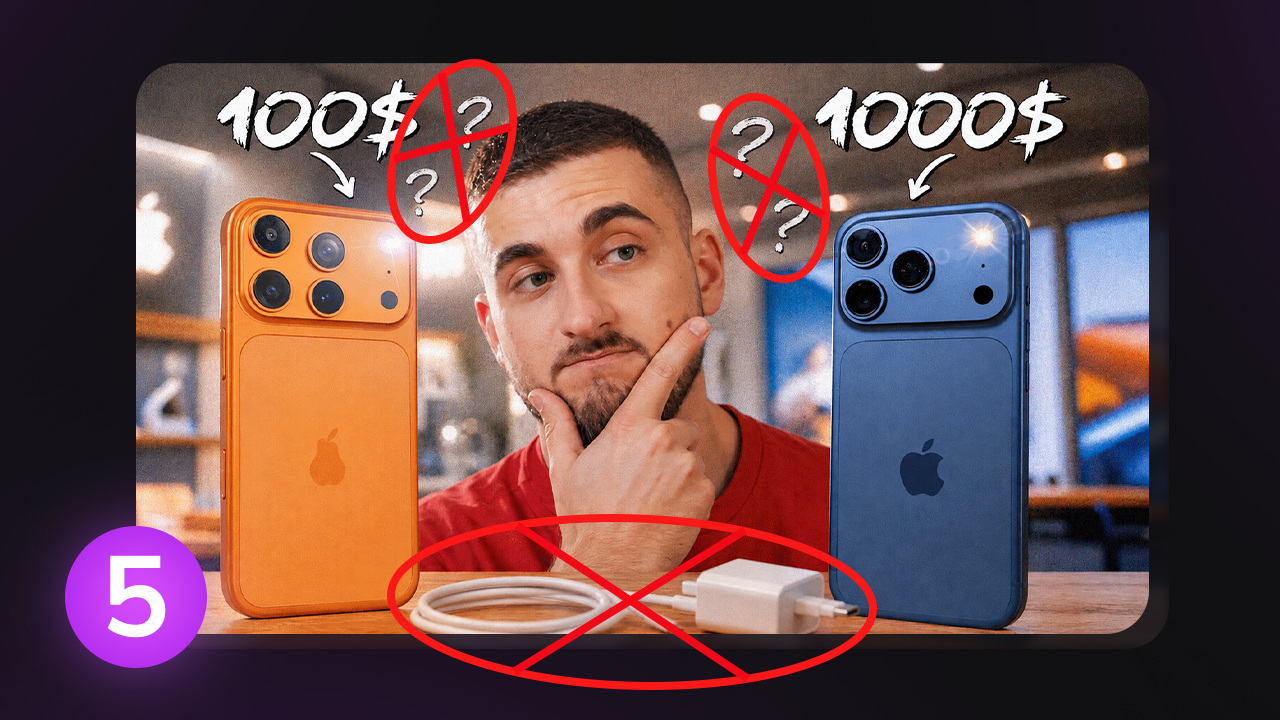
Titles and thumbnails work best as two halves of one story: the title supplies context, the thumbnail supplies the emotion, the conflict, or the consequence. When both say the same thing, half your packaging is wasted.
Title: I spent 3 days in Warsaw's cheapest hotel
Thumbnail: It was awful
The subject is clear, the payoff isn't. That's interest without deception.
Put the most interesting part in the first 40 characters, because mobile cuts titles off. And strip out the throat-clearing that sneaks into every first draft: "in this video," "today I'm going to show you," "everything you need to know," "actually." We covered title writing in depth separately, in our guide to naming YouTube videos.
Why a high CTR doesn't always mean success
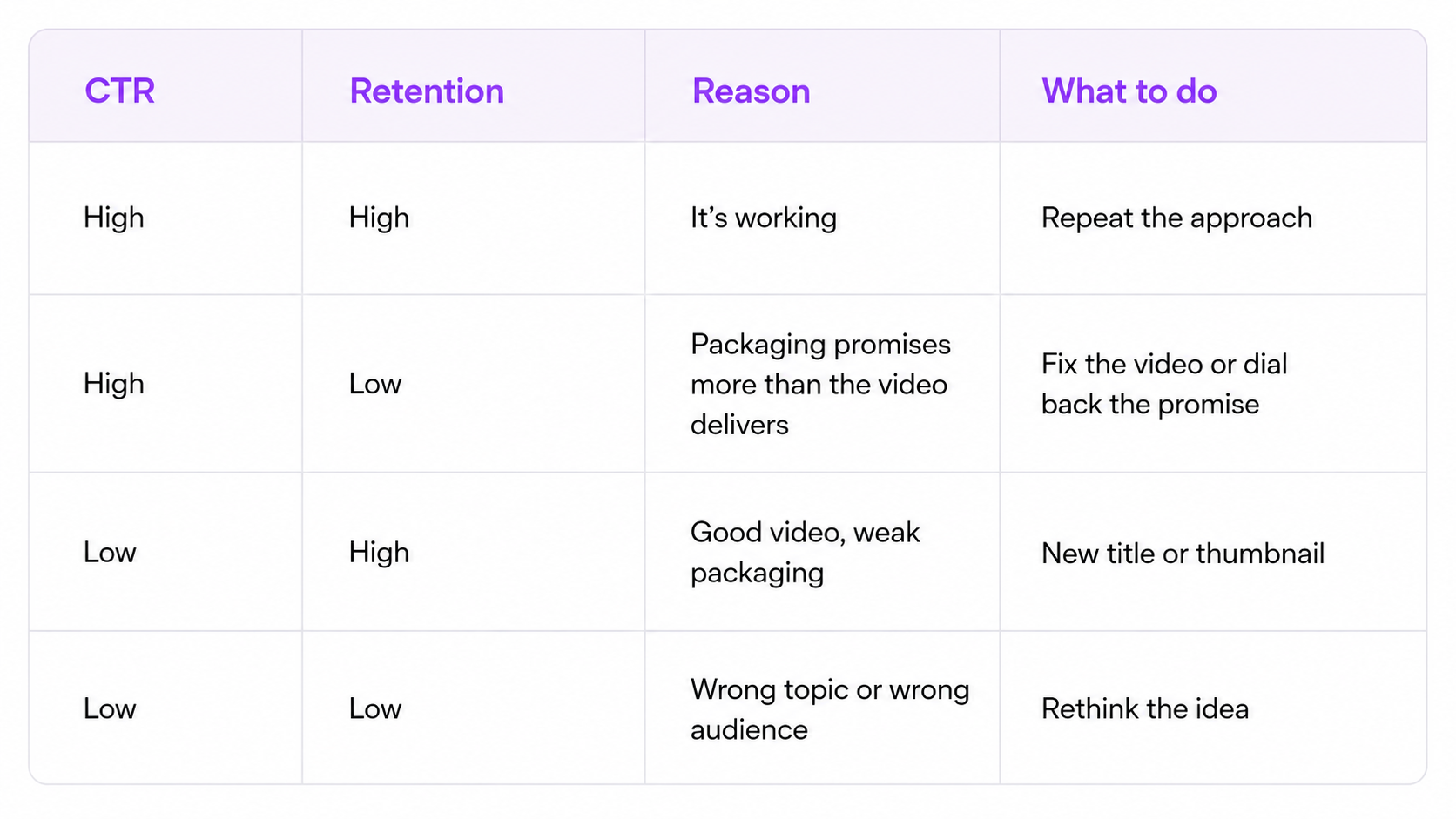
CTR says the viewer wanted to open the video. Retention says they wanted to stay.
Row two is the one to worry about. A click followed by an immediate exit does more damage than no click at all.
How to improve your YouTube CTR
Improving YouTube CTR rarely starts with the thumbnail.
1. Define the video's main promise first. Before you design anything, answer this: what will someone understand or see after watching? If that's hard to say in one sentence, the topic isn't sharp enough yet.
2. Split the work between title and thumbnail. Let the title explain the context while the thumbnail shows the consequence, the emotion, or the result.
3. Trade vague words for specifics. Add a number, a problem, or an outcome.
4. Check the thumbnail at small size. Within two seconds, the main point should be obvious.
5. Cut the extra elements. Every additional detail pulls attention away from the core idea.
6. Test different ideas, not small color tweaks. Compare a problem against a result, a face against an object, a fact against an emotion.
7. Look for your own patterns. Find what the videos with strong CTR and strong retention have in common, and build from there.
Conclusion
A high CTR doesn't mean the video is fine. The 2–10% range works as a rough reference point, but judging it in isolation from everything else gets you nowhere. What matters is how many people saw the video, where they came from, and what they did after the click.
Thumbnails and titles perform best when they build one clear promise together. The viewer should understand right away what they're getting. That's why strong channels don't just change colors, fonts, and text placement — they test different ways of presenting the idea itself.
And the click is only the beginning. If someone opens the video and leaves immediately, a high CTR won't grow the channel. That's especially true on the road to monetization, where retention and watch time carry far more weight.
FAQ
What is a good CTR on YouTube? For a lot of channels, 4–6% is the working range, but you have to judge it alongside impressions, traffic source, and retention. YouTube calls 2–10% typical for half of all channels and videos.
Where do I find CTR in YouTube Studio? Open Analytics, pick a video, and go to the Reach tab. You'll see impressions, CTR, views, traffic sources, and watch time there.
Is a 10% CTR good? Usually, yes, but check impressions first. Ten percent of 1,000 impressions is 100 views; 4% of 500,000 is 20,000. High percentages often come from a small sample, search traffic, or distribution that skewed heavily toward subscribers.
Is a 3% CTR bad? Not by itself. For a video YouTube is actively showing to a new audience on the home page, 3% can be a perfectly normal result.
Does YouTube reward a high CTR? Not directly. A high CTR shows that your thumbnail and title grab attention, but clicks alone aren't enough. If viewers leave quickly, that percentage won't help the video travel.
What matters more, CTR or watch time? They work together. CTR brings the viewer in; watch time and watch quality show whether the video met expectations. You need both, but retention is the steadier signal.
When should I change a thumbnail? When you have enough impressions for the data to be reliable, the percentage is below normal for your channel, retention is good, the topic is still relevant, and you have a genuinely different idea to test.
Why did my CTR suddenly drop? Most often because distribution expanded to a colder audience. Compare impressions over the same period: if views went up while the percentage went down, there's nothing to fix.
Can clickbait raise CTR? Briefly, and at the cost of retention, trust, and future impressions. Misleading thumbnails can also break YouTube's policies.
Does YouTube count external impressions? No. Thumbnails on external sites, in embedded players, and on end screens don't count. That's exactly why YouTube CTR can look out of step with your view count when you have heavy external traffic.
Why is my CTR high but my views low? Most likely the video didn't get many impressions. A high percentage is no guarantee that YouTube will widen distribution.
How can I improve YouTube CTR? Start with the idea, not the design: one clear promise, context in the title, consequence on the thumbnail, specific words instead of vague ones, readability at mobile size, and then real tests of genuinely different concepts through Test & Compare.