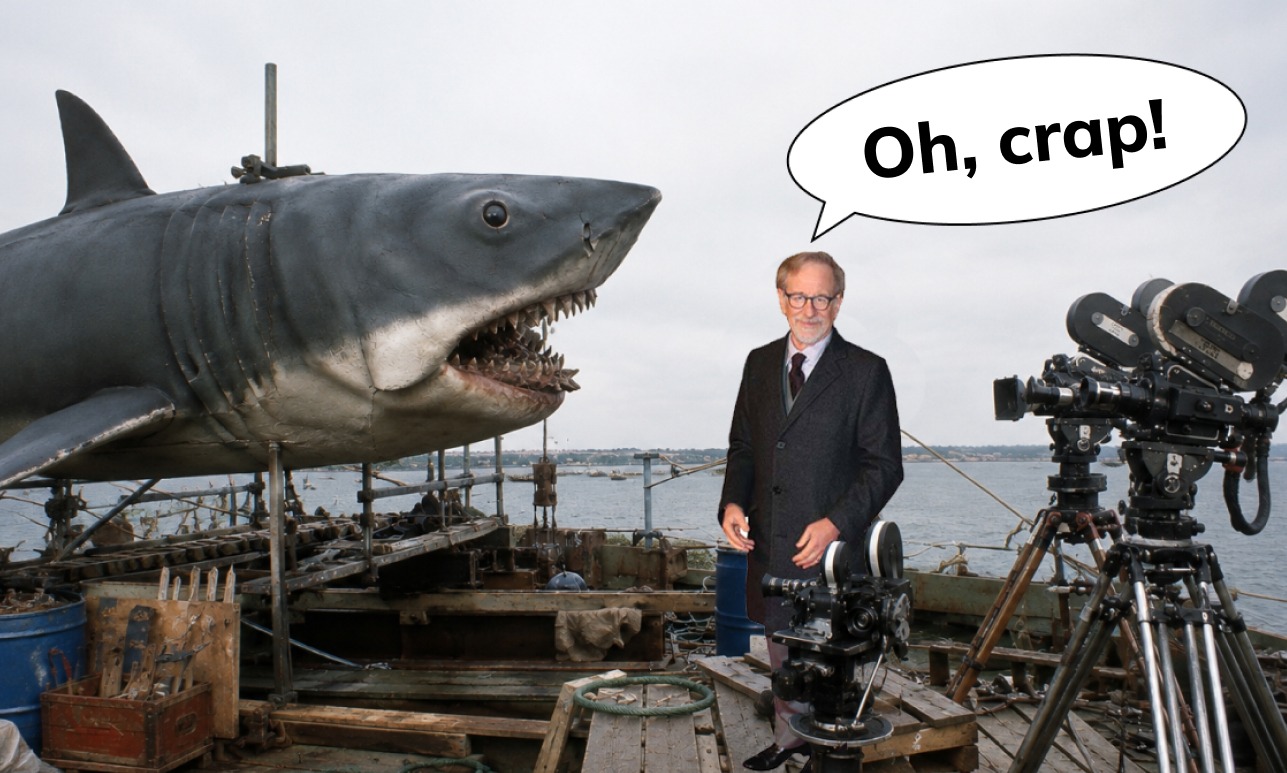
It’s 1974. A film set on Martha’s Vineyard. Steven Spielberg is staring at the ocean and waiting. The mechanical shark, weighing more than a ton and built over months by the crew, has broken down again. The three shark models, collectively known as “Bruce,” constantly malfunction in saltwater. The budget is spiraling. Production stretches to 159 days instead of the planned 55.
Just a few minutes of screen time required engineers, special effects specialists, complex machinery, and millions of dollars. All of that was needed to make viewers believe a scene that today can be created with a single text prompt in a video generation tool.
Artificial intelligence is no longer a tool used only by enthusiasts. It has become part of the daily workflow of thousands of creators: writing scripts, voicing characters, translating videos into different languages, editing footage, and generating entire scenes from scratch.
This is changing how creators make content on YouTube, how viewers consume it, and how the platform itself evaluates quality.
What Are AI-Generated Shorts?
AI-generated Shorts are short-form videos ranging from 60 seconds to 3 minutes in length, where artificial intelligence plays a key role in the creation process. However, it is important to distinguish between two fundamentally different approaches.
Partially AI-assisted content means the creator records or prepares the material themselves, while AI helps with specific elements. For example, a person records a video, and AI provides the voiceover, adds subtitles, or translates it into another language. The foundation remains human-made.
Fully AI-generated content means the entire video-from visuals to audio-is created using algorithms. The creator writes a prompt, and AI generates the video, adds a voice, edits it, and even selects the music.
Common Tools Used to Produce AI Shorts
AI voice generation (ElevenLabs, Murf, Speechify) provides realistic voiceovers without a microphone or voice actor
Text-to-video generation (Sora, Veo, Kling, Runway) allows creators to describe a scene and receive a finished video clip
AI subtitles (Descript, Captions, CapCut) automatically transcribe audio and style captions
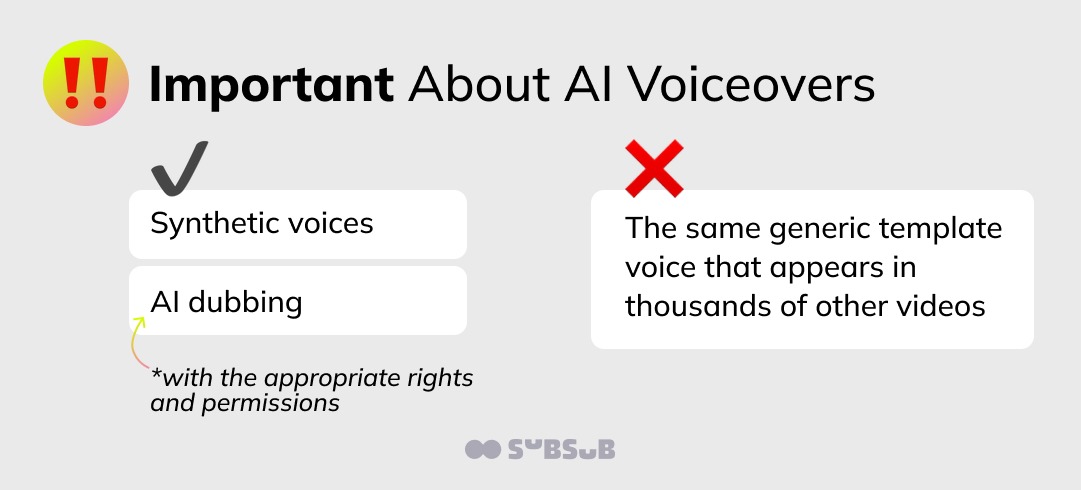
AI translation and dubbing synchronize lip movements and voiceovers in a new language without re-recording
AI avatars (HeyGen, Synthesia) generate realistic video presenters that read scripted text
AI editing tools analyze footage and automatically select the best moments
Why Creators Are Adopting AI at Scale
Time Savings. Producing a traditional Short typically takes between 2 and 8 hours. Scriptwriting, recording, editing, subtitles, and uploading all require time. With AI, the same process can be reduced to 60–120 minutes. For creators with automated workflows, production time can drop to as little as 30 minutes.
Scalability. One creator can only produce so many videos per day. An AI-powered channel can publish significantly more. Some creators operate 5–10 channels simultaneously across different niches.
Faster Niche Testing. Previously, testing whether audiences were interested in topics like finance or science required weeks of production. Now, creators can generate 10 Shorts in a week and evaluate performance based on the results.
Localization. AI dubbing can transform one English-language video into five versions in different languages. Channels that once reached only English-speaking audiences can quickly expand into Spanish, Portuguese, Hindi, and Arabic markets.
Lower Costs. Studio voiceovers cost money. Videographers cost money. AI tools are often more affordable while covering a significant portion of those needs.
The Scale of AI Content on YouTube in 2026
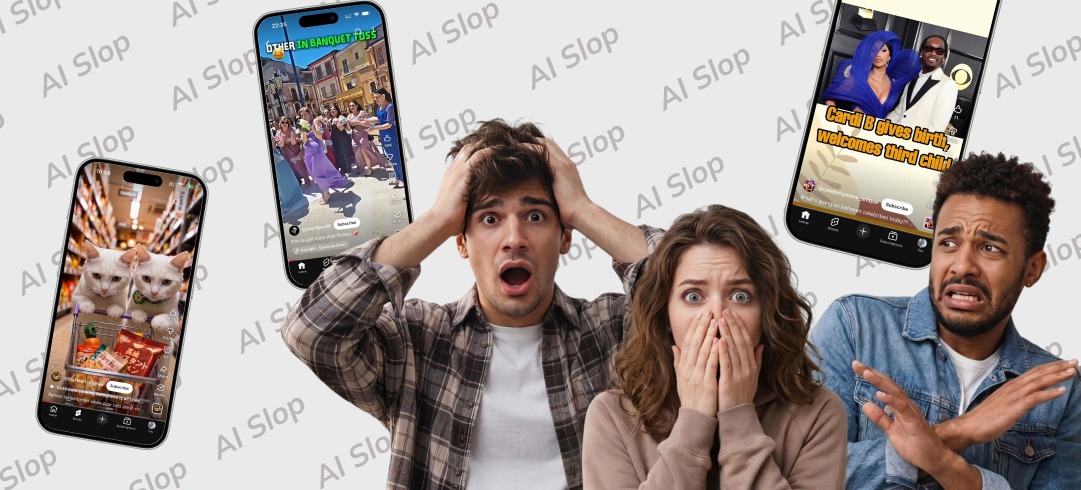
The barrier to creating videos is lower than ever before. But alongside new opportunities came a new problem: AI Slop.
This term has become widely used within the YouTube community to describe mass-produced, low-quality AI content. Thousands of channels publish nearly identical videos built from the same templates. AI voices read Wikipedia articles over stock footage. Generated “facts” go unchecked. The content lacks perspective, originality, and value.
This flood of repetitive content began overwhelming the platform and tiring viewers. YouTube responded quickly by placing greater emphasis on authenticity. The algorithm also became more effective at identifying template-driven videos and reducing their reach.
How AI Shorts Affect Monetization
This is one of the biggest concerns among creators. While outcomes depend on how AI is used, certain patterns are already becoming clear.
YouTube does not prohibit AI-generated content. This is important to understand from the beginning. Simply using AI does not violate platform policies and does not automatically lead to demonetization.
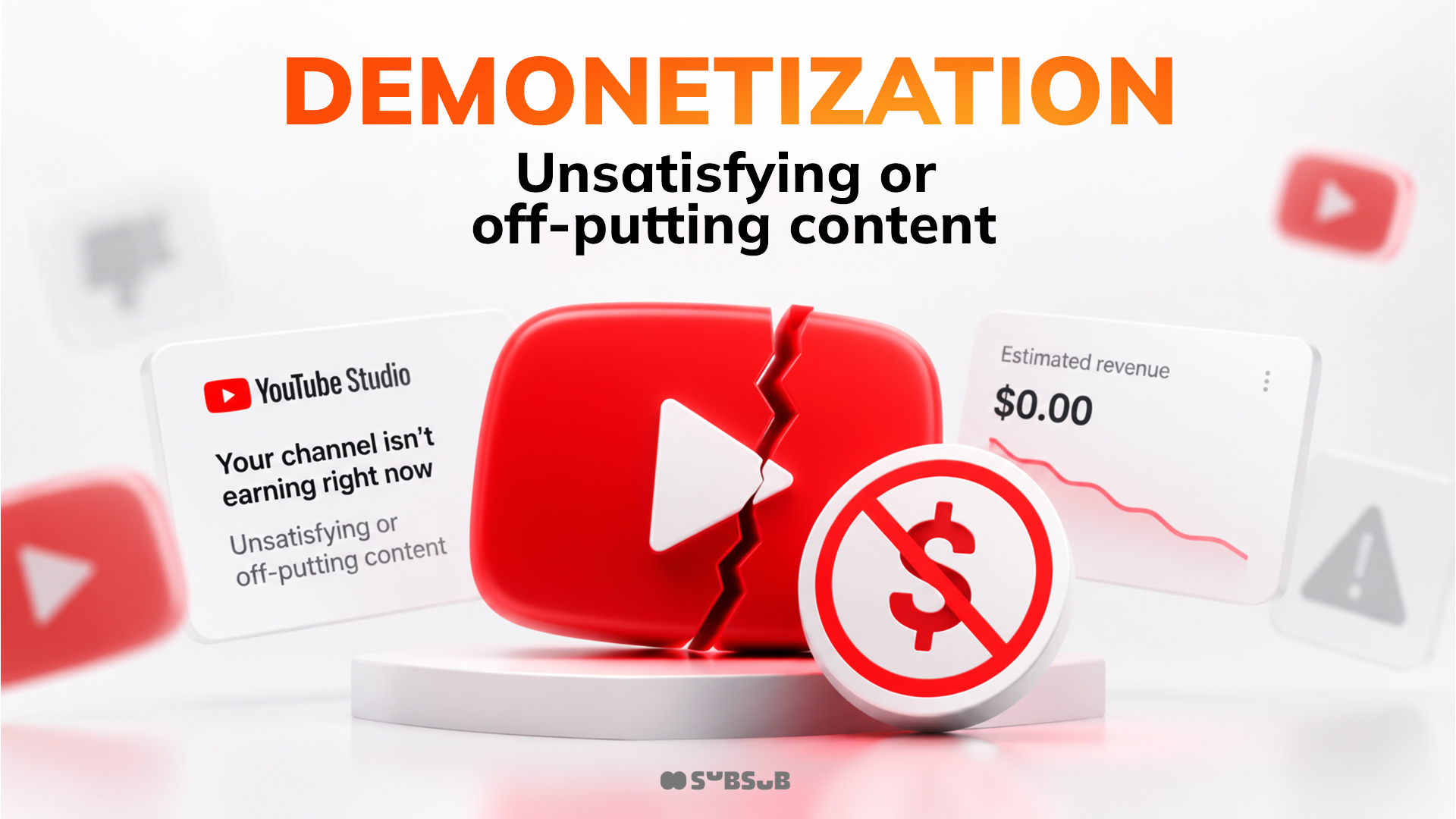
However, YouTube is not fighting AI-it is fighting unoriginal and low-quality content. That is why it is important to understand what YouTube considers inauthentic content. This includes videos with no meaningful creative contribution, the reuse of third-party materials without transformation, or mass-produced content that provides little value to viewers.
Despite its efforts against low-quality content, YouTube is investing heavily in AI. The platform continues to release AI-powered tools for creators.
Dream Screen allows creators to generate or modify backgrounds in Shorts using text prompts. A creator describes a scene, and AI generates a visual environment that can be used immediately.
Dream Track enables creators to generate short AI-created music tracks for Shorts. The creator provides a mood or style, and the system produces a unique soundtrack.
Veo, developed by Google DeepMind, powers YouTube’s AI video-generation tools. It is one of the core models behind Google’s most advanced video generation capabilities.
Automatic dubbing translates and revoices videos into multiple languages, helping creators expand beyond a single-language audience.
Additionally, YouTube Studio is gradually introducing an AI assistant called Ask Studio, which functions like a conversational tool for generating video ideas, creating scripts, structuring content, and receiving channel growth recommendations.
New YouTube Rules for AI Content
In May 2026, YouTube updated its approach to AI-content labeling. According to the YouTube team, viewers want to understand what is real and what has been created or significantly altered using artificial intelligence.
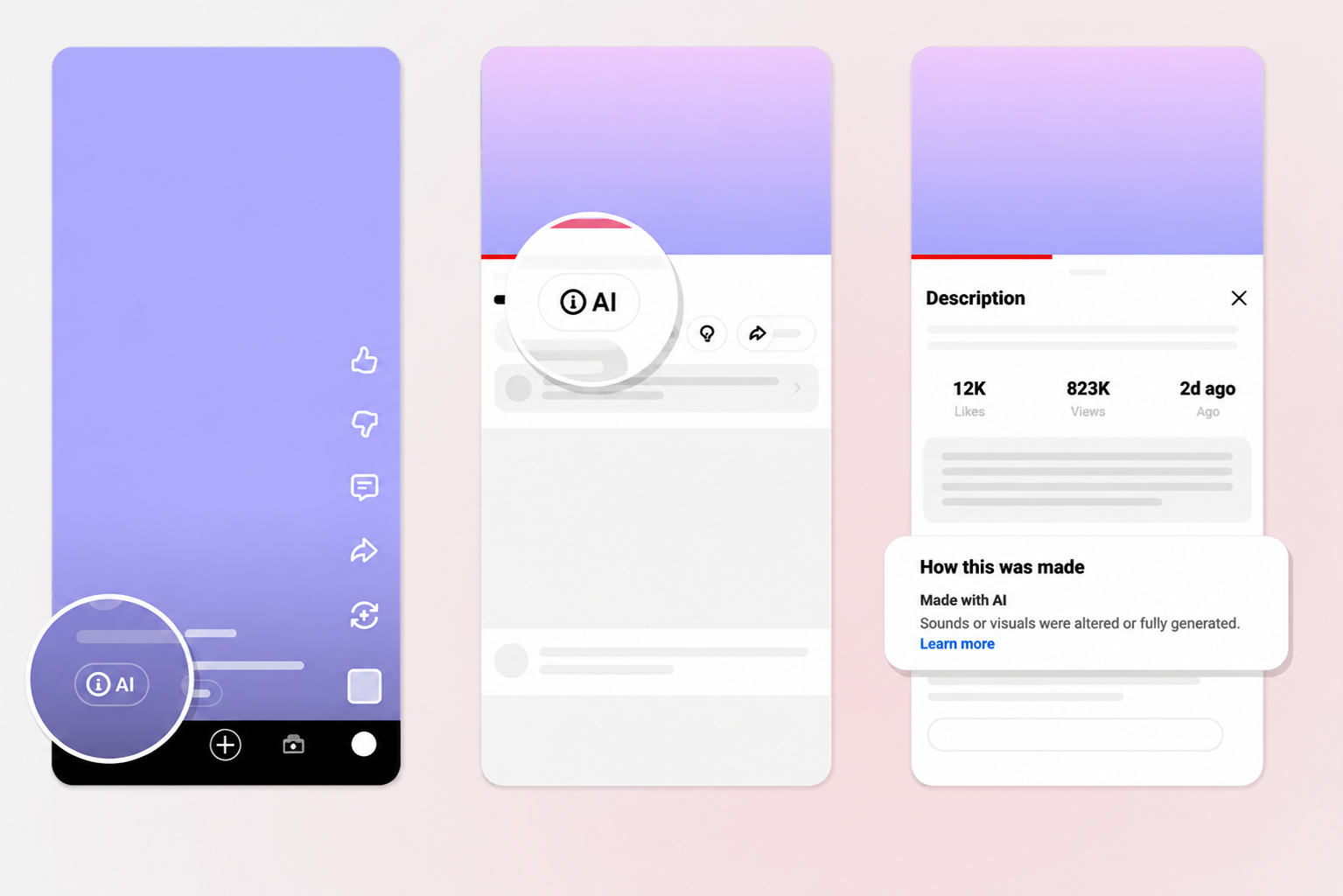
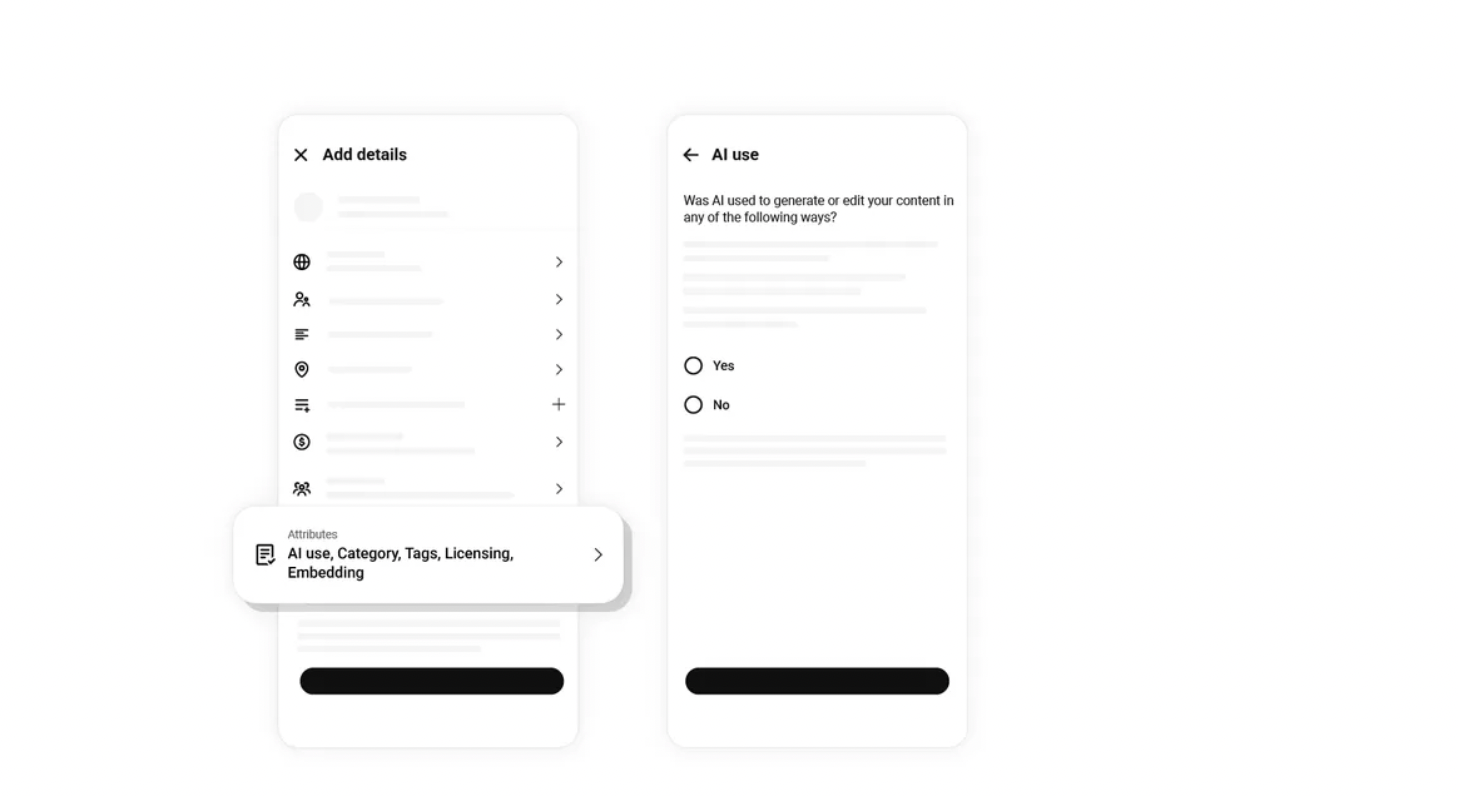
The biggest change is the introduction of more visible labels. For long-form videos, labels now appear directly beneath the video player. In Shorts, they appear directly on the video itself. For animation, artistic content, and minor modifications, AI disclosures remain in the description.
Another major update is automatic AI detection. Beginning in May 2026, YouTube started using new internal signals to identify significant photorealistic AI-generated content. If a creator fails to disclose AI usage and the system detects it, YouTube may add the disclosure automatically.
At the same time, creators retain some control. If a creator believes their content was incorrectly identified as AI-generated, they can update the disclosure status in YouTube Studio. However, disclosures remain permanent in certain cases, including:
Content created using YouTube’s own AI tools such as Veo or Dream Screen
Content containing C2PA metadata indicating it was fully generated using generative AI
When You Must Disclose AI Usage
A disclosure is required when content appears realistic and could reasonably be interpreted as authentic. Examples include:
A real person appears to say or do something that never actually happened (such as an AI-generated video where MrBeast announces a $10 million giveaway for all subscribers, or Tim Cook announces a free iPhone for every Apple user);
Events are shown that never occurred (such as realistic footage of an earthquake in New York, a volcanic eruption in Iceland, or a fire at the White House that never happened);
Real places, people, or events are altered (such as AI adding Taylor Swift to the Oscars when she was not present, or showing Lionel Messi joining a club he never signed for).
Disclosures are not required for animation, fictional scenes, artistic content, image or audio enhancements, or other changes that are unlikely to mislead viewers under YouTube’s altered or synthetic content policies.
Does This Affect Monetization?
No. YouTube has specifically stated that AI-content labels do not affect recommendations, reach, or monetization eligibility.
For the platform, transparency matters more than AI usage itself. However, repeatedly concealing AI-generated content may lead to consequences. YouTube may remove videos for policy violations or restrict access to the YouTube Partner Program.
If you have questions about YouTube policies or a specific situation on your channel, contact us at creators@subsub.cc or on Telegram at @subsub_admin. We’ll help you разобраться.
AI Shorts Formats That Work in 2026
Not all AI content performs equally well. The strongest formats are those where AI helps create content rather than replacing the creator’s ideas.
AI Stories, Social Content, and Mini-Documentaries. Short stories about real events, personal experiences, social issues, or inspiring moments. AI provides visualizations, while the creator remains responsible for storytelling, presentation, and emotional impact.
Educational Shorts. Science, psychology, medicine, finance, and technology continue to be among the strongest niches. AI makes it easier to explain complex ideas through visuals and animation, but success depends on information quality-not the tools themselves.
Historical Reconstructions. From ancient civilizations to twentieth-century events, AI makes it possible to visualize moments that could never have been filmed. Audience interest in historical content continues to grow.
Motivational and Expert Content. AI avatars and synthetic voices can work effectively when supported by genuine expertise, personal experience, or a unique perspective. Attractive visuals alone are no longer enough.
Virtual Hosts and AI Characters. Channels featuring AI avatars as presenters continue to gain popularity. They perform best when creators are transparent about AI usage and do not attempt to present the character as a real person.
Formats provide the foundation for content creation. However, even the strongest format cannot succeed without the right topic. In many cases, what you talk about matters more than how you present it.
The next step is understanding demand-identifying which topics audiences are actively searching for and adapting them to your style.
This is where growth opportunities emerge. At SubSub, we developed a tool that matches your channel’s niche with current search trends and generates video ideas at the intersection of audience demand and your expertise. Instead of spending hours on manual research, you receive a curated list of topics that people are already searching for and that fit your channel.
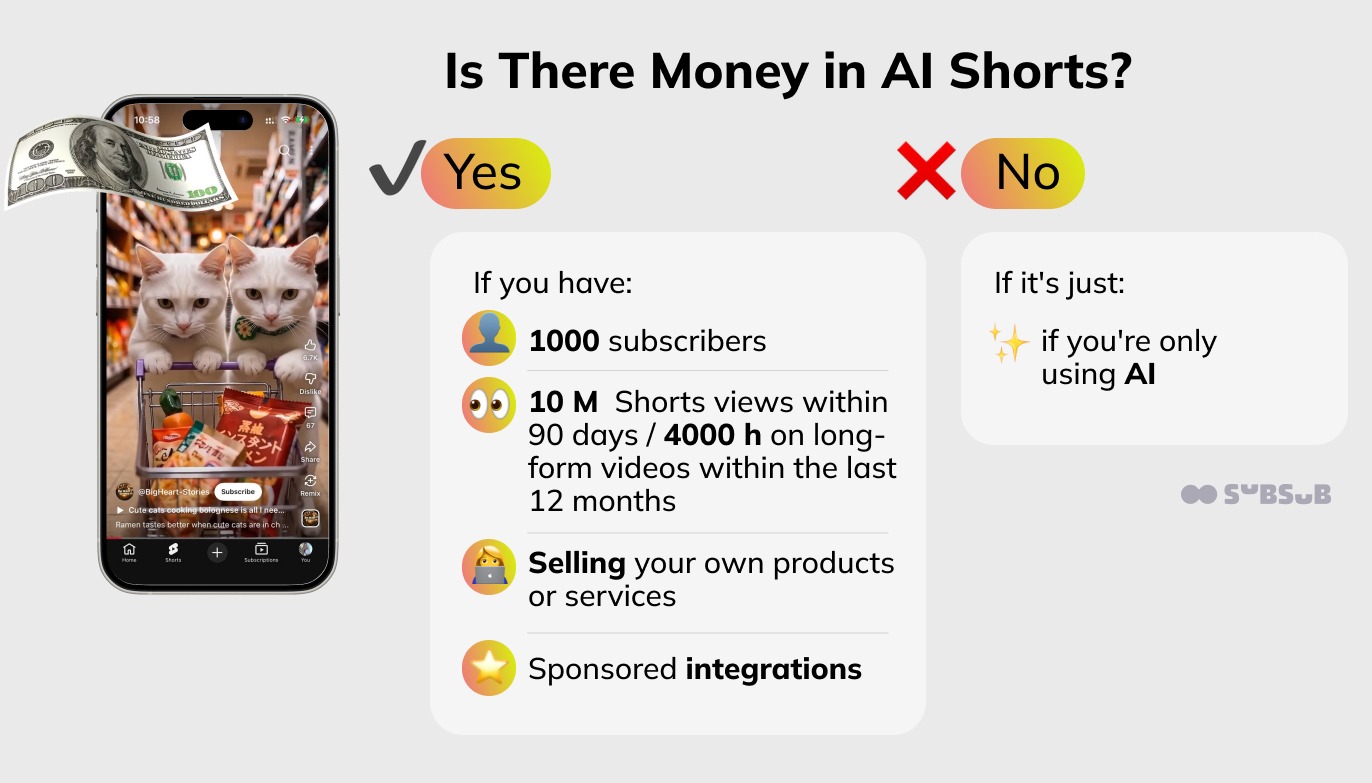
Monetization of Shorts through the YouTube Partner Program works. The requirements are: 1,000 subscribers and 10 million valid Shorts views within 90 days, or 4,000 watch hours from long-form videos over the past 12 months. For channels that publish a high volume of content, these thresholds can be reached faster, but the format itself (AI or not) does not provide any special advantages in meeting monetization requirements.
Additional income sources:
Selling your own products or services through Shorts as a traffic funnel. Short videos act as a lead magnet for courses, consultations, digital products, or communities
Sponsored integrations. These are harder to secure for fully AI-driven channels without a personal brand, but they are still possible with a stable audience and consistent viewership
Advantages and Disadvantages of Running an AI Shorts Channel
Advantages
Dramatically reduced production time per video
Ability to manage multiple channels simultaneously
Easy scaling without hiring a team
Affordable localization into dozens of languages
Fast testing of topics and formats
Consistent content output even with a busy schedule
Disadvantages
Difficult to build audience loyalty without human connection
AI tools evolve constantly, requiring continuous learning
Standing out is difficult without a distinctive creator voice
Advertisers are often cautious about AI channels without a human face
Risk of being flagged for unoriginal content and losing platform access through “related channel” violations
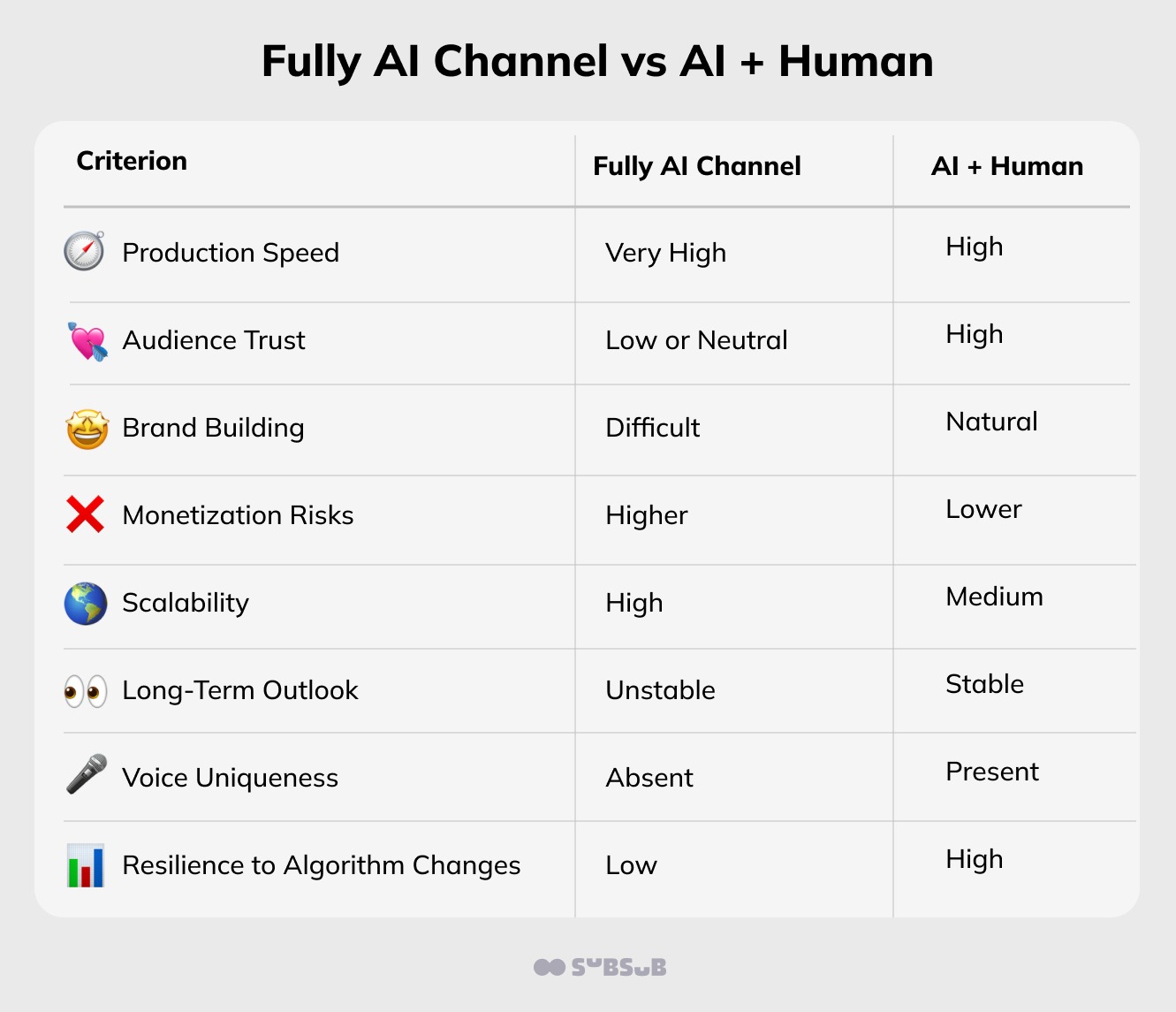
Fully AI Channel or AI + Human
AI is no longer a competitive advantage.
Video generation, voiceover, editing, and localization tools are available to everyone. The real competitive advantage is the creator.
Their experience cannot be generated. Their opinions are shaped by years of work, learning, and mistakes. Their personal style helps audiences recognize them among thousands of similar videos. Their ability to notice what others overlook and talk about it in a unique way creates genuine differentiation.
Technology truly opens new possibilities. But people are the ones who give those possibilities meaning.
We can help you find that meaning. SubSub offers a 30-day optimization challenge designed to build this habit. Every day, you receive a specific task, complete it, and submit the result for review. Participation costs $100 for the entire program (approximately $3 per task). The strongest participants may receive an opportunity to join the SubSub team.