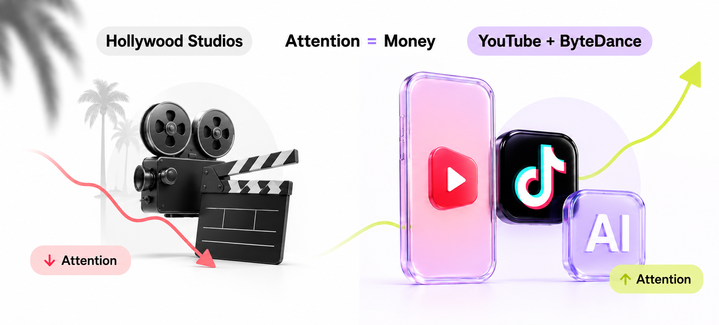
According to Media Partners Asia, the two most valuable media companies in the world today are ByteDance and YouTube. Each is valued at over $500 billion, roughly twice as much as a traditional Hollywood studio. Money follows attention, and attention is increasingly focused on content created not by studios but by individual creators-and more and more often, with the help of AI.
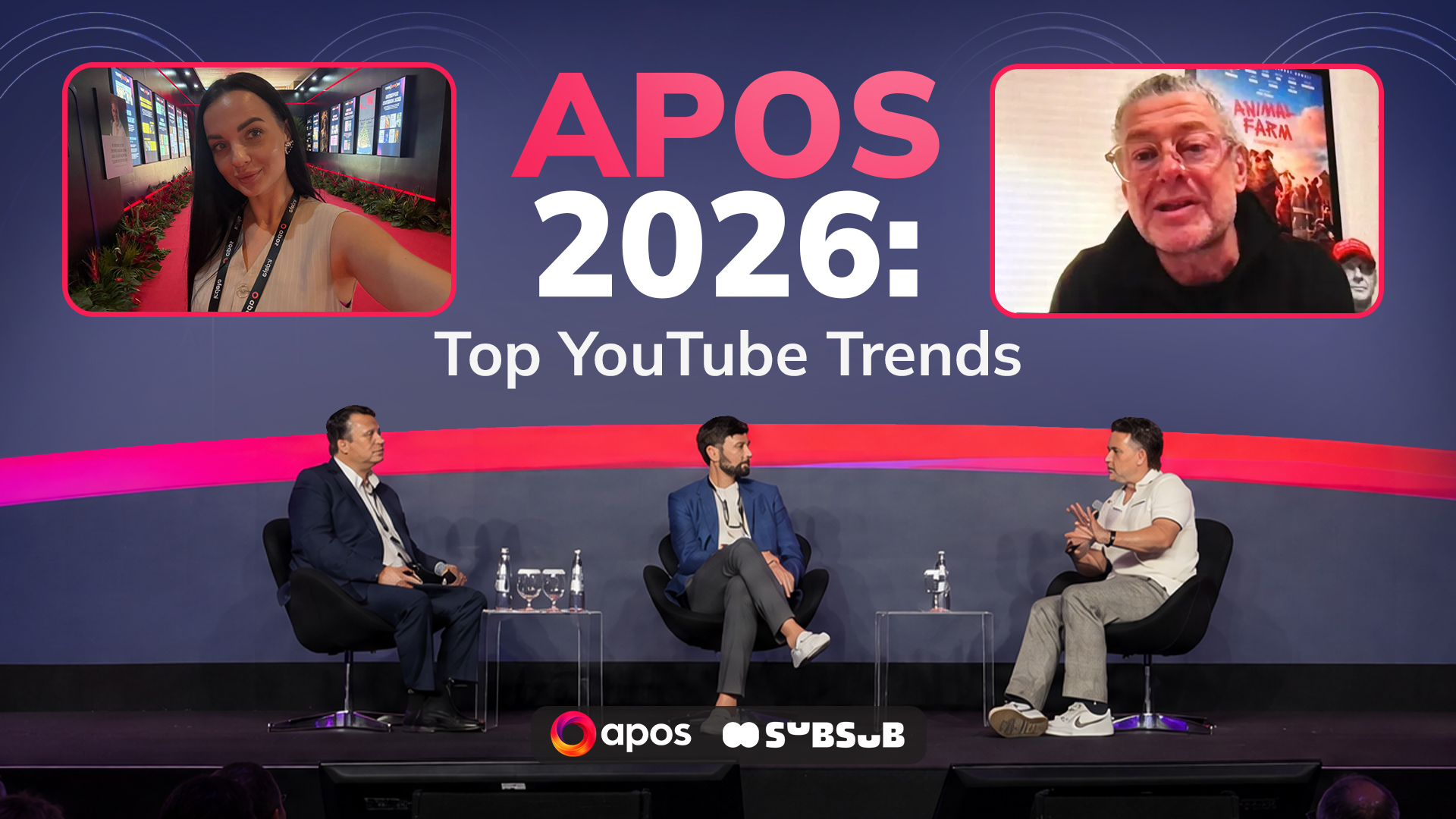
That’s why storytelling in the age of AI was the main theme at APOS 2026, one of the leading media conferences in the Asia-Pacific region. The SubSub team attended the conference, spoke with participants and speakers to understand where the industry is headed-and is ready to share its observations.
The most revealing conversation took place during the panel “The New Creative Pipeline: AI, Intellectual Property, and Human Craftsmanship.” Actor and director Andy Serkis, screenwriter Josh Nelson Youssef, and Google Vice President John Zepp-three people who approach AI from opposite perspectives. But instead of arguing, they kept coming back to one question: where does the tool end and the creator begin?
The Actor, Not the Computer: Who Really Creates a Digital Character
Serkis spoke about his journey in the industry-he started out in theater. The stage, he says, taught him the most important lesson: a story works when the audience experiences it alongside the actors, rather than watching from the sidelines.
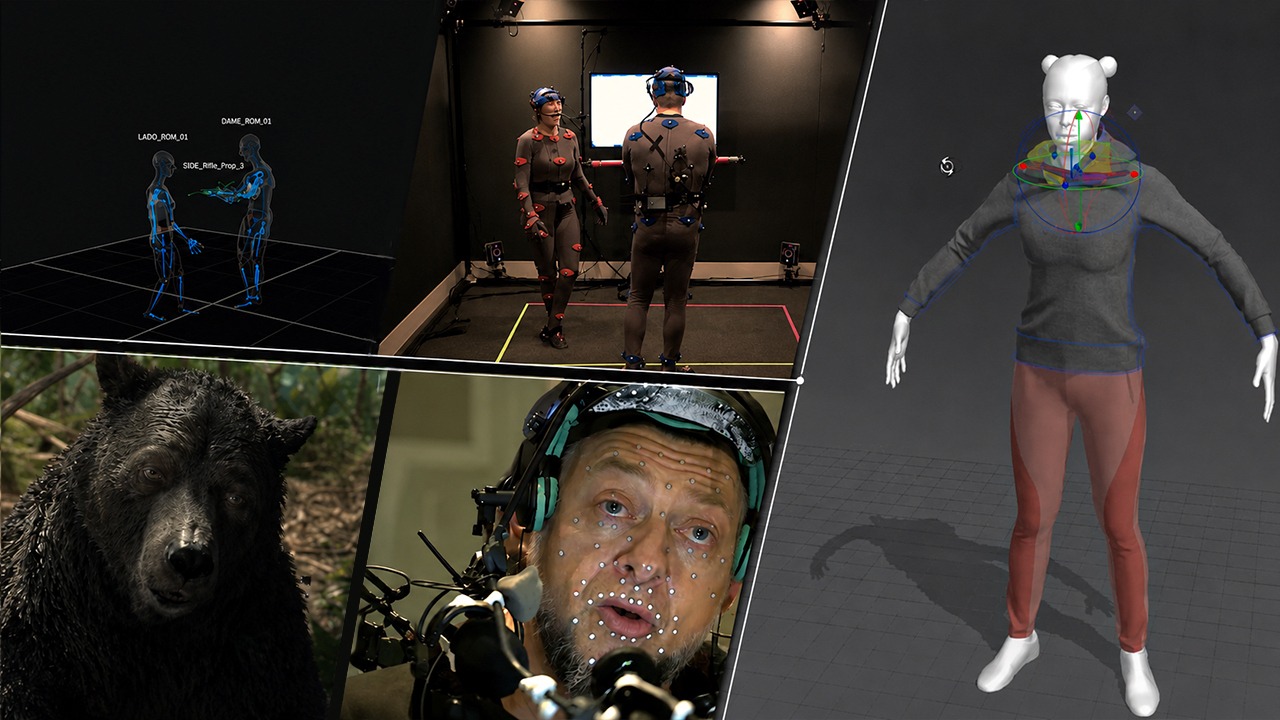
That’s exactly why he founded his own studio, Imaginarium Studios a team of directors, screenwriters, and artists who are passionate about telling stories in a new way: digital stories. Together with the actors, they create digital characters. Motion capture technology records the actor’s movements, facial expressions, and gestures, and artists transform them into a digital character. But it is the actor who gives the character a voice, personality, and emotions. The technology merely helps bring this performance to the screen. As Serkis says, it does not replace acting skill.
AI Storytelling: How It Reshapes Creating,Producing, and Watching Content
What he’s most looking forward to is seeing how young directors, screenwriters, and artists will use these tools to create stories that we can’t even imagine today. We wrote about how the approach to content creation is changing in our article “How AI-Generated YouTube Shorts Will Change Creators in 2026.”
Josh Nelson Youssef has articulated the idea of increased production speed very well.
According to him, artificial intelligence drastically shortens the path between the emergence of an idea and its visual realization. What took months of preparation just a few years ago can now be seen as a prototype almost immediately using AI tools. Thanks to this, creators can quickly test different concepts, modify them without significant time or resource costs, and abandon unsuccessful ideas even before full-scale production begins. This allows for much more experimentation, helps identify successful ideas faster, and makes it possible to understand much earlier whether a concept works. At the same time, the director emphasized that these new tools should not replace the creative process. They are meant to help creators test their own ideas more quickly, not to make decisions for them.
AI Storytelling: How It Reshapes Creating, Producing, and Watching Content
That is why, in their new project-a mixed-reality experience for the Google Android XR platform-the team uses AI as a tool rather than a substitute for creativity. They apply it in two ways.
The first involves interaction with characters. One of the project’s characters is capable of having a full-fledged conversation with the viewer. According to Youssef, until recently, such an experience was available only in immersive theater or special interactive productions. Thanks to artificial intelligence, such formats are gradually becoming accessible to a much wider audience. At the same time, it was fundamentally important for the team not simply to create an interactive character, but to preserve its human nature, emotions, and natural way of communicating.
The second application of AI is less noticeable to the viewer but no less important for production. All final animation in the project is created by artists by hand. Artificial intelligence is used only during the preparation phase to quickly test the frame composition, camera movement, or different scene variations before the animators begin their work.
Content Becomes Interactive
According to Serkis, it is not cinema itself that is changing, but the role of the viewer. And it’s being transformed by immersive formats: 360° video, where the viewer rotates the camera themselves; virtual reality (VR), where an entire world unfolds around them through a headset; mixed reality, where digital characters appear right in the room; and interactive stories, in which the viewer chooses where the plot goes. In each of these formats, the viewer finds themselves in the thick of the action, talking to characters, and sometimes influencing what happens. Serkis considers this shift from observation to participation to be the main direction of storytelling.
While Serkis and Youssef spoke mainly about the creative process, John Zepp offered a perspective from the platform’s side, which analyzes the behavior of hundreds of millions of users every day. According to him, Google is already seeing clear signs of how audience expectations are changing. It’s not enough for people to simply watch content; they want to interact with it.
This isn’t a new idea for YouTube. Creators are already interacting with viewers through comments and live streams. Previously, annotations-clickable prompts overlaid on videos-were also used for this purpose, but YouTube removed them in 2019. End screens now partially fulfill that function. Some of the best-known examples of interactive storytelling are Markiplier’s projects on YouTube and Netflix’s “Bandersnatch.”
According to Zepp, AI is changing the approach to storytelling. Interactive videos existed before, but back then, all plot options had to be written out in advance. Now the story can change as it unfolds: characters respond to the viewer’s questions rather than just reacting to pre-written scripts. As a result, the viewer goes from being a mere observer to becoming a participant in the story.
Why Everyone's Suddenly Talking About Microdramas - and What It Means for Vertical Video
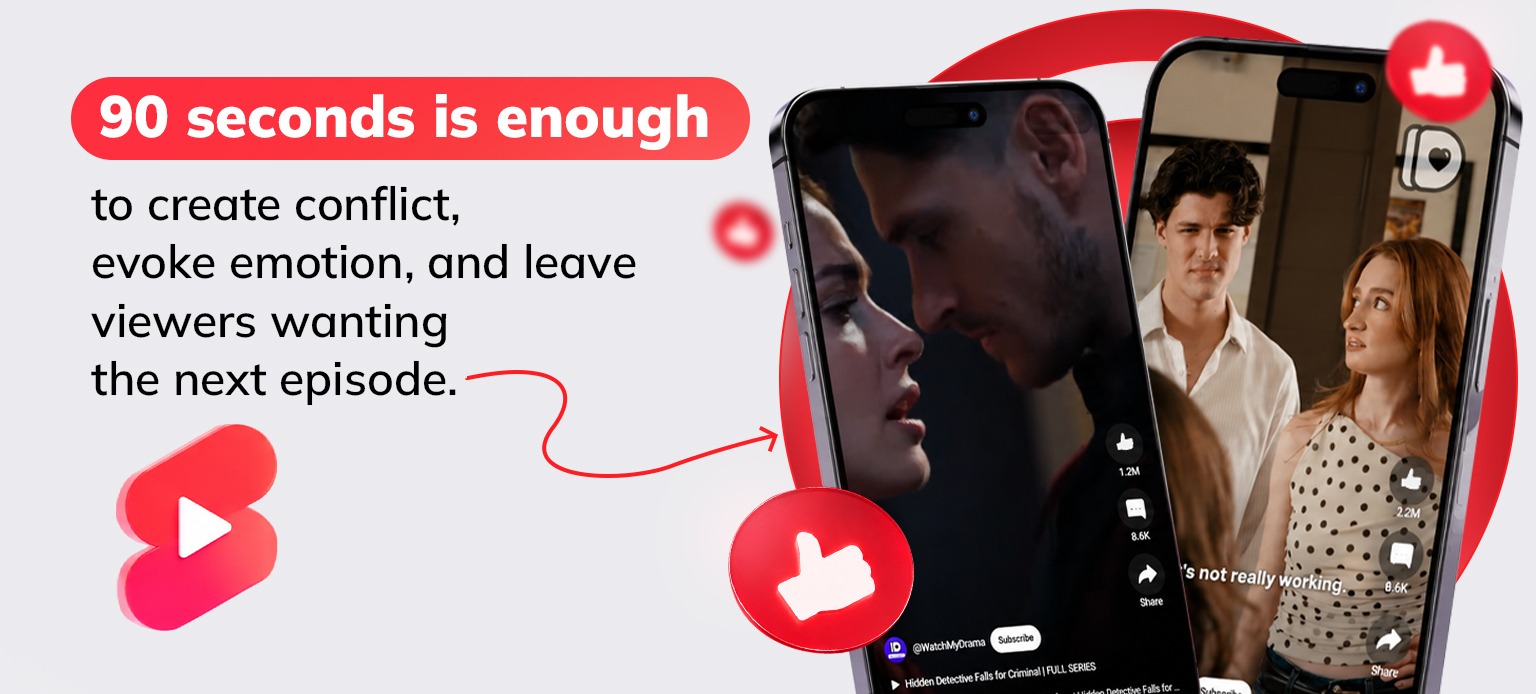
Microdramas were discussed almost as frequently as AI. John Zepp explained that Google has long recognized this trend through Google Play and Android-audiences are increasingly eager to watch short, vertical stories. And it’s not just about the runtime. Microdramas show that stories can be told differently: in short episodes, quickly responding to audience preferences and adapting to the mobile screen.
Google is investing directly in the format. Together with the agency Range Media Partners, the company is developing the 100 ZEROS production project-an entire lineup of vertical series featuring well-known producers, including Mike Fleiss (creator of *The Bachelor*) and Simon Fuller (creator of *American Idol*). Premieres are released on the Google TV app, and later on other platforms.
However, Zepp emphasized that the platform should not dictate what the content will be-whether a feature-length film, a vertical micro-drama, or an interactive story. Google’s goal is to provide creators with tools, not to impose a specific format.
The format itself began to develop actively primarily within apps: the global leaders are ReelShort and DramaBox, and in Ukraine, it’s Holywater with its My Drama app, which we at SubSub also work with. On YouTube, they’re growing the My Drama channels: Romance & Drama Stories and My Drama Shorts, which build their strategy around vertical romantic series-including stories featuring LGBTQ+ characters-and regularly garner millions of views. One of their micro-dramas, *Spark Me Tenderly*, has garnered over 7 billion views on social media and led to a deal with Fox. Distribution is increasingly shifting to YouTube Shorts as well. This clearly illustrates a trend: while a few years ago short vertical videos were considered a separate genre, today they are becoming a full-fledged storytelling format with their own narrative techniques, pacing, and ways to hold viewers’ attention.
Gollum: Where the Line Runs Between Human and AI
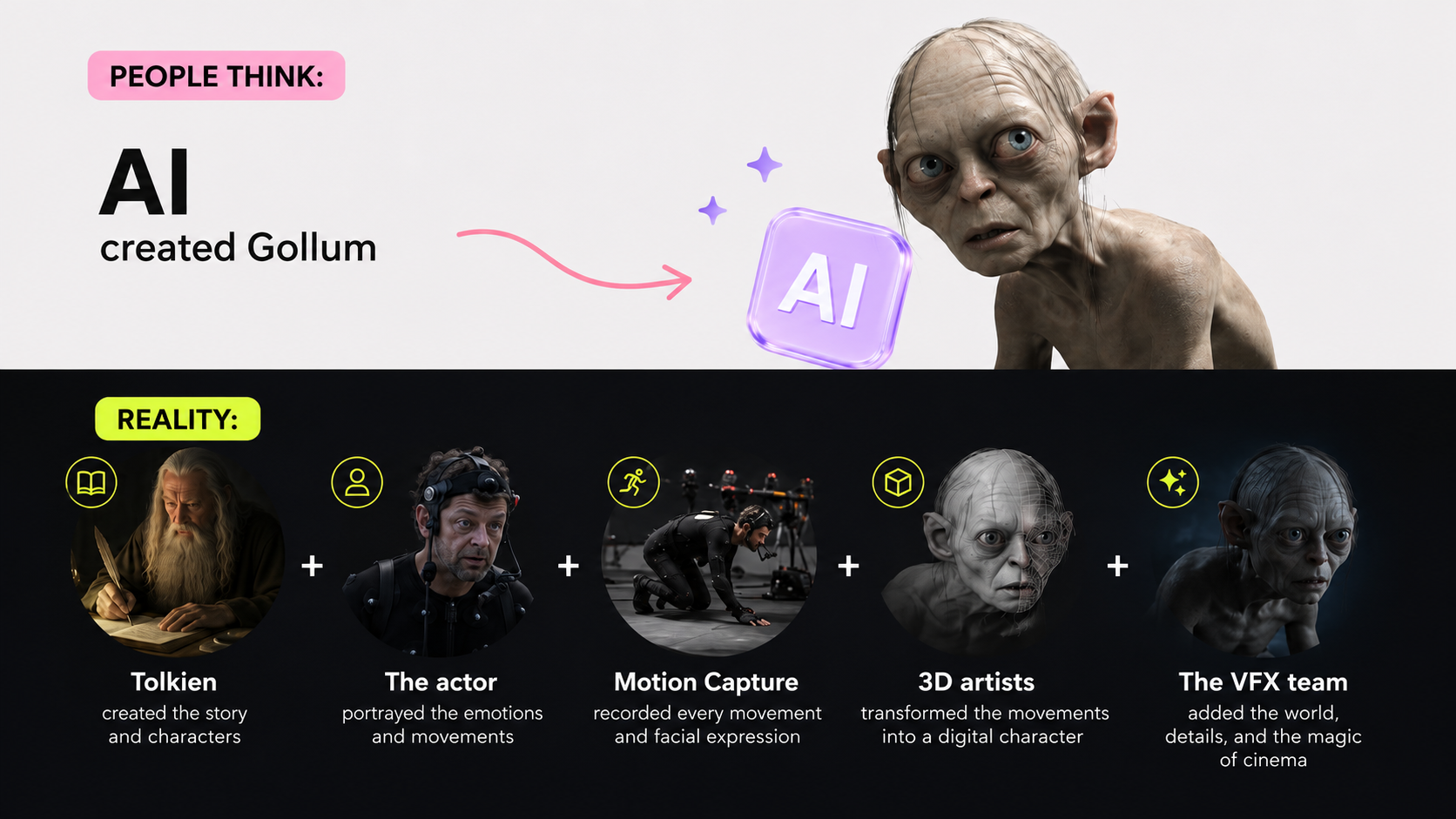
If content is created by artificial intelligence, who is its author? The story of Gollum explains the answer well.
There is a misconception that Gollum was created by a computer. In reality, a large creative team is behind this character. Gollum was originally conceived by J. R. R. Tolkien. Then, artists spent years refining his appearance. Andy Serkis gave him his voice, body language, facial expressions, and personality using motion capture technology. Only then did dozens of CG artists and animators transform all of this into the character we saw on screen. Technology became a tool, not the creator of Gollum.
YouTube takes a similar approach. The platform does not restrict the use of generative AI, but expects a human to be behind the content. It is the creator who must make creative decisions, shape the idea, and create value for the viewer. If a channel publishes a large amount of templated or inauthentic content created with almost no human involvement, it may lose its monetization. We’ve already covered this in more detail in our article “Inauthentic Content: Why So Many Creators Are Getting Demonetized.”
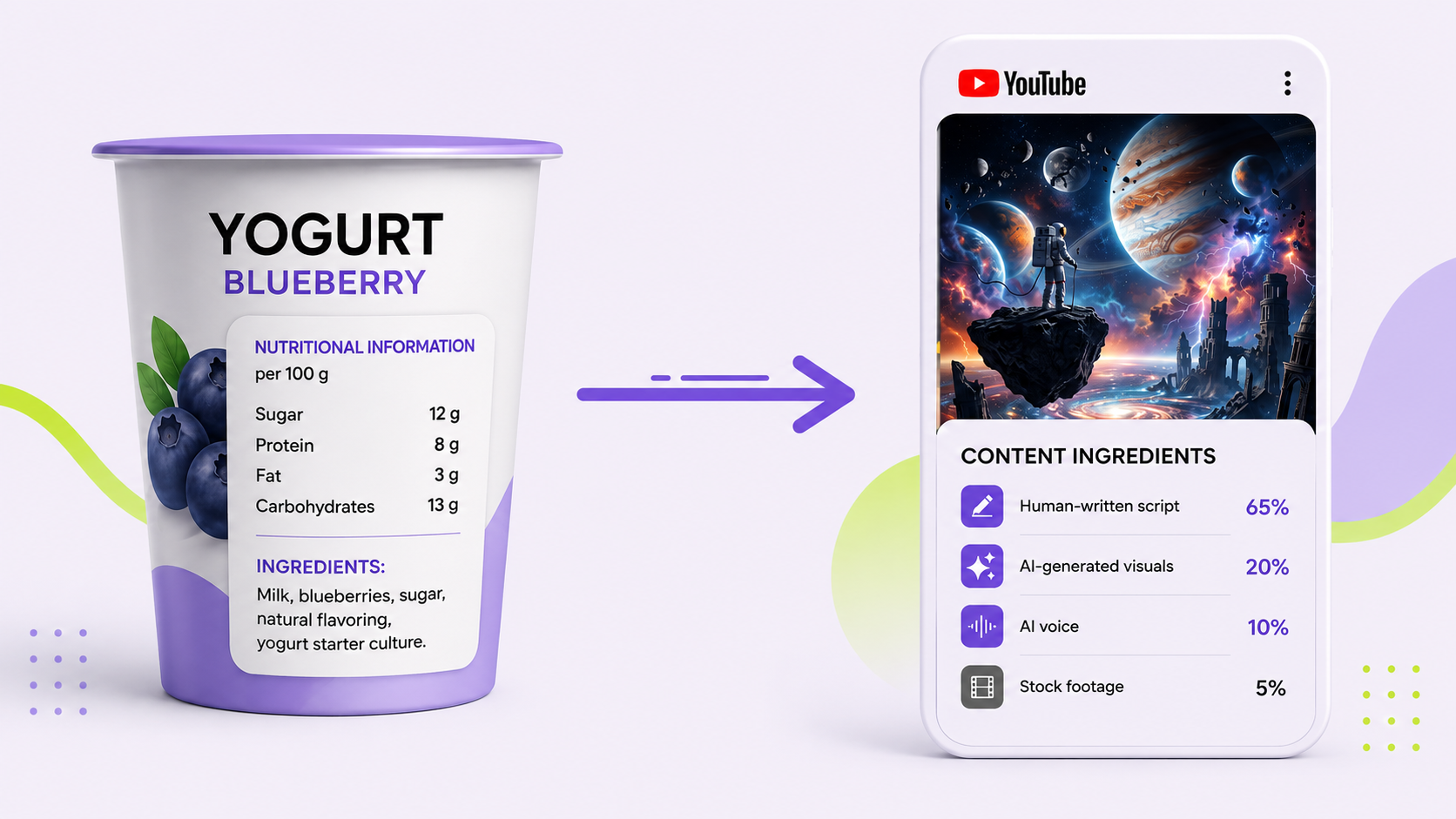
Audiences Now Check Content “Ingredients” Like Food Labels
YouTube once revolutionized the very model of content distribution: virtually anyone could upload a video and reach an audience. This led to a rapid increase in the number of creators and the volume of content.
Now the industry is undergoing the next stage of this same transformation. Content creation tools, particularly generative models, are becoming accessible to a much wider audience. Along with this, the importance of trust in content is growing. Whereas audiences used to easily distinguish real content from generated content, that line has now almost disappeared. Therefore, it is becoming increasingly important not only the content itself, but also who created it, how, and with what tools.
According to Andy Serkis, the approach to transparency should depend on the type of content. In news, documentaries, and any factual material, the origin of the information must be as clear as possible. The viewer must know who created the content, what sources were used, and where verified facts end and reconstruction or generation begins. Here, transparency is not a mere preference but the foundation of trust.
In fictional stories, if artificial intelligence serves as a tool and does not replace the creator, the narrative itself remains the priority: does the story work, does it captivate the viewer, and what emotions does it evoke? In this case, the audience evaluates not so much the production technology as the power of the creative vision.
However, the discussion about transparency isn’t limited to simply labeling AI in videos. An equally important issue currently concerning tech and media companies is the training of generative models. These models operate on large datasets of existing human-created content, which raises the question: how should we acknowledge the contributions of the creators whose texts, images, music, or videos served as the basis for training?
Consequently, there is an increasingly active discussion about new mechanisms for attribution, licensing, and fair compensation for rights holders. It is likely that new rules governing the creative industry will take shape around these principles in the coming years.
What YouTube Creators Can Take Away from APOS 2026
Despite differing views on the future of AI, the speakers agreed on one thing: technology does not replace humans. For YouTube creators, this leads to several practical conclusions.
Technical skill is no longer an advantage. When powerful tools are available to almost everyone, what becomes valuable is the ability to come up with a story that others will want to experience. A complex video no longer requires a large budget or a team. A video requires an idea.
The short vertical format is a full-fledged format. It can be used on its own or to tell bigger stories. The success of micro-dramas has confirmed this. So mastering Shorts is a must.
Build your own community and prioritize transparency. Zepp advises creators to develop a community that exists independently of individual platforms. This allows you to communicate, draw inspiration, and find like-minded people. In the age of AI, this is critical: a connection with your audience doesn’t happen automatically-it must be built consciously. Fan-funding services, such as Patreon or our Fan Funding, help with this.
Let’s conclude with the words of Andy Serkis: “The world is changing rapidly. But human creativity will evolve alongside it.”