Two YouTube creators with the same audience size can earn dramatically different amounts of money. One relies entirely on advertising revenue. The other has diversified their monetization sources and earns 5-10 times more without publishing more videos.
The key difference is not the audience itself, but how that audience is monetized. In this article, we'll explore four of the most common monetization models used by today's content creators:
YouTube monetization - AdSense and viewer support (Super Chats, Channel Memberships, paid reactions)
Patreon - direct audience support through subscriptions
Substack - paid email newsletters for a loyal community
Amazon Associates - passive income through product recommendations
YouTube Monetization: Advertising and Fan Funding
YouTube Advertising - creators on YouTube earn revenue through advertising monetization (AdSense). Their earnings are determined by the number of views and the value of the ads shown in their videos. It's important to understand two key metrics:
CPM (Cost Per Mille) - the amount an advertiser pays for 1,000 ad impressions. This is the advertiser's cost, not the creator's revenue. On YouTube, CPM can vary significantly depending on the country, niche, and the channel's audience
RPM (Revenue Per Mille) - the creator's actual earnings per 1,000 views after YouTube takes its 45% share of advertising revenue
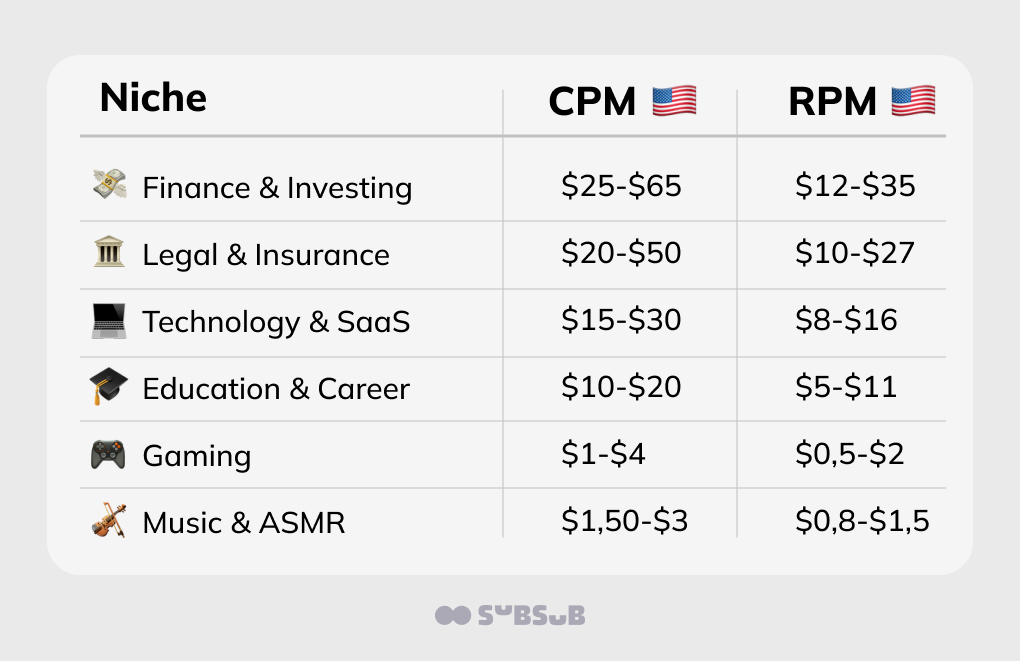
Estimated RPM by niche
Factors That Affect Revenue
Audience Geography. RPM is heavily influenced by the country your viewers come from. In the United States, it typically averages around $5-12 across most niches, compared to $4-9 in the United Kingdom and $3-8 in Germany. In India, RPM is usually around $0.8-3 per 1,000 views. Channels with audiences in lower-spending markets generally earn less because advertisers in those countries pay lower advertising rates
Seasonality. Advertising budgets increase during the fourth quarter, especially in November and December. In January, budgets tend to shrink, and RPM can drop by 30-50% across almost all niches
Content Format. YouTube Shorts creators typically earn between $0.01 and $0.06 RPM per 1,000 views. A video with one million views in this format may generate only $10-60 in advertising revenue
Example
A channel with 100,000 monthly views and an average RPM of $5 will earn about $500. The same channel in the finance niche with an RPM of $20 will earn around $2,000.
However, reaching 100,000 monthly views often takes years of work. An algorithm change can cut views in half without warning - this is the biggest risk of a model that relies solely on advertising revenue. That's why many creators look for additional income streams, including YouTube Fan Funding.
YouTube Fan Funding
Direct viewer support within the YouTube ecosystem:
Super Thanks - one-time donations under videos
Super Chat / Super Stickers - donations during livestreams
Channel Memberships - monthly subscriptions with exclusive community perks
This model monetizes the community rather than traffic:
Not "how many people watched the video"
but "how many people are engaged enough to financially support the creator"
Pros
No need to send your audience to another platform
Payments happen directly on YouTube
Lower barrier to entry for donations
Can work well even with relatively low view counts
Cons
Dependence on the YouTube ecosystem
Platform fees. YouTube keeps approximately 30%, while creators receive around 70%
More difficult to collect audience contact information compared to Patreon or Substack
Example
A channel with 100,000 subscribers might have:
500 members × $5 membership fee = $2,500/month
Super Thanks, Super Chat, and Super Stickers = an additional $300-1,500/month
For comparison, the same channel with 100,000 monthly views and a $5 RPM would earn only $500 from ads.
Patreon: The Direct Subscription Model
The audience pays a fixed monthly amount in exchange for exclusive content or access to a community.
Subscription Tiers
Basic Tier ($3-5/month) - for people who want to support the creator symbolically. Usually includes access to a private chat or a thank-you mention in video descriptions
Mid-Tier ($10-15/month) - typically the largest subscriber segment. Creators offer exclusive videos, early access, behind-the-scenes content, or access to a private Discord server
Premium Tier ($25-50/month) - designed for the most loyal supporters. Personal acknowledgments, participation in Q&A sessions, or influence over future video topics
Important: Each support tier should offer clear value or include a specific call to action, rather than simply asking viewers to send money.
Pros
Predictable monthly income (when consistently maintained)
Direct relationship with the most loyal audience members
Revenue per subscriber is significantly higher than revenue per view
Allows creators to monetize a small but highly engaged audience
Cons
Requires ongoing production of exclusive content
Since August 2025, Patreon has introduced a standard 10% fee for all new creators. Previously, there were three plans: Lite (5%), Pro (8%), and Premium (12%)
Subscriptions purchased through the iOS app are subject to Apple's fee of up to 30%. Patreon offsets this by increasing prices for iOS users by approximately 43%, making app subscriptions more expensive than website subscriptions
Subscriber churn is inevitable, requiring creators to continuously attract new supporters
Example
A channel with 10,000 active subscribers where 2% convert to Patreon at an average subscription price of $8/month:
200 subscribers × $8 = $1,600/month
After Patreon fees and payment processing charges (~13%): approximately $1,390/month
Сhannel earning ad revenue with 100,000 monthly views and a $5 RPM would make $500. Patreon generates more revenue with a smaller audience if that audience is highly engaged.
In addition to Patreon, some creators use alternative fan funding platforms with lower fees (around 5%). For example, SubSub Fan Funding allows creators to optimize revenue from direct audience support through a lower platform fee.
Substack: Do Newsletters Pay?
Substack is a platform for independent creators that allows monetization through paid email newsletters. Creators publish content partially or entirely behind a paywall, and readers pay a monthly or annual subscription fee for access.
Substack is designed for creators whose value comes from analysis, expertise, or unique perspectives. The platform performs particularly well for:
Journalists and analysts with strong personal viewpoints
Creators in finance, technology, legal, and political niches
YouTube creators with loyal audiences seeking deeper insights than videos can provide
Pros
Paid newsletters typically cost between $5 and $15 per month. Mid-level creators often earn between $2,000 and $10,000 per month - enough to support full-time work in many countries
Substack creators who incorporate audio or video grow revenue 50% faster than those who publish only text. This gives YouTube creators who also run newsletters a structural advantage over text-only writers
Creators own their email lists - an asset that remains theirs regardless of platform or algorithm changes
According to Substack, the average email open rate is around 44%. This means a significant portion of subscribers actively read newsletters rather than letting them sit unopened in their inboxes
Cons
Subscriber churn remains the biggest risk
Not suitable for audiences that consume only video content and rarely read long-form text. In such cases, paid subscription conversion rates will remain low regardless of content quality
Substack takes 10% of paid subscription revenue, plus Stripe payment processing fees. Total costs typically range from 13-16% of revenue. There are no monthly platform fees - creators pay nothing until subscribers start paying
Example
At a $10 monthly subscription price: 500 paying readers generate $5,000/month in revenue. After Substack and Stripe fees, the creator keeps approximately $4,250-4,350 per month.
We've compiled a list of successful Substack publications for inspiration. To access it, fill out the form.
Amazon Associates: Passive Income Through Affiliate Links
Amazon Associates is an affiliate program that allows creators to place referral links to Amazon products and earn a commission on every sale. While the previous models monetize content or community support, Amazon Associates monetizes trust in a creator's recommendations.
Amazon Associates works particularly well for:
Tech, gadget, and product review creators
Beauty, fitness, and home decor channels
Educational creators recommending books and learning materials
Any creator who regularly mentions specific products
Revenue depends entirely on three variables: channel traffic, link click-through conversion, and average order value.
Pros
Relatively passive income - you can earn by recommending products that already appear in your content
Commission rates vary by category. Amazon Games offers the highest rate at 20%. Luxury beauty products and Amazon Explore pay 10%. Most standard categories, including electronics and general retail products, pay between 1% and 4.5% of sales value
Amazon offers fixed payouts for service sign-ups, ranging from $3-25 for Prime, Audible, Kindle Unlimited, and other subscriptions
If a viewer clicks a link and adds a product to their cart, the creator still earns a commission if the purchase is completed within 89 days
Cons
Low commission rates in most popular categories (1-4.5%), requiring significant traffic for meaningful income
The cookie window is only 24 hours for direct purchases (89 days applies only to items added to a cart)
The program is not ideal for creators without stable traffic. Amazon may close accounts that generate no sales within 180 days
Payments are available only through bank transfer or Amazon gift cards, which can be inconvenient for creators outside the United States
Example
50,000 monthly views
2% click-through rate = 1,000 clicks
5% purchase conversion rate = 50 purchases
Average order value: $80
3% commission = $2.40 per purchase
Total earnings: approximately $120/month
Amazon Associates rarely becomes the primary revenue source for mid-sized channels, but it works well as a supplementary income stream.
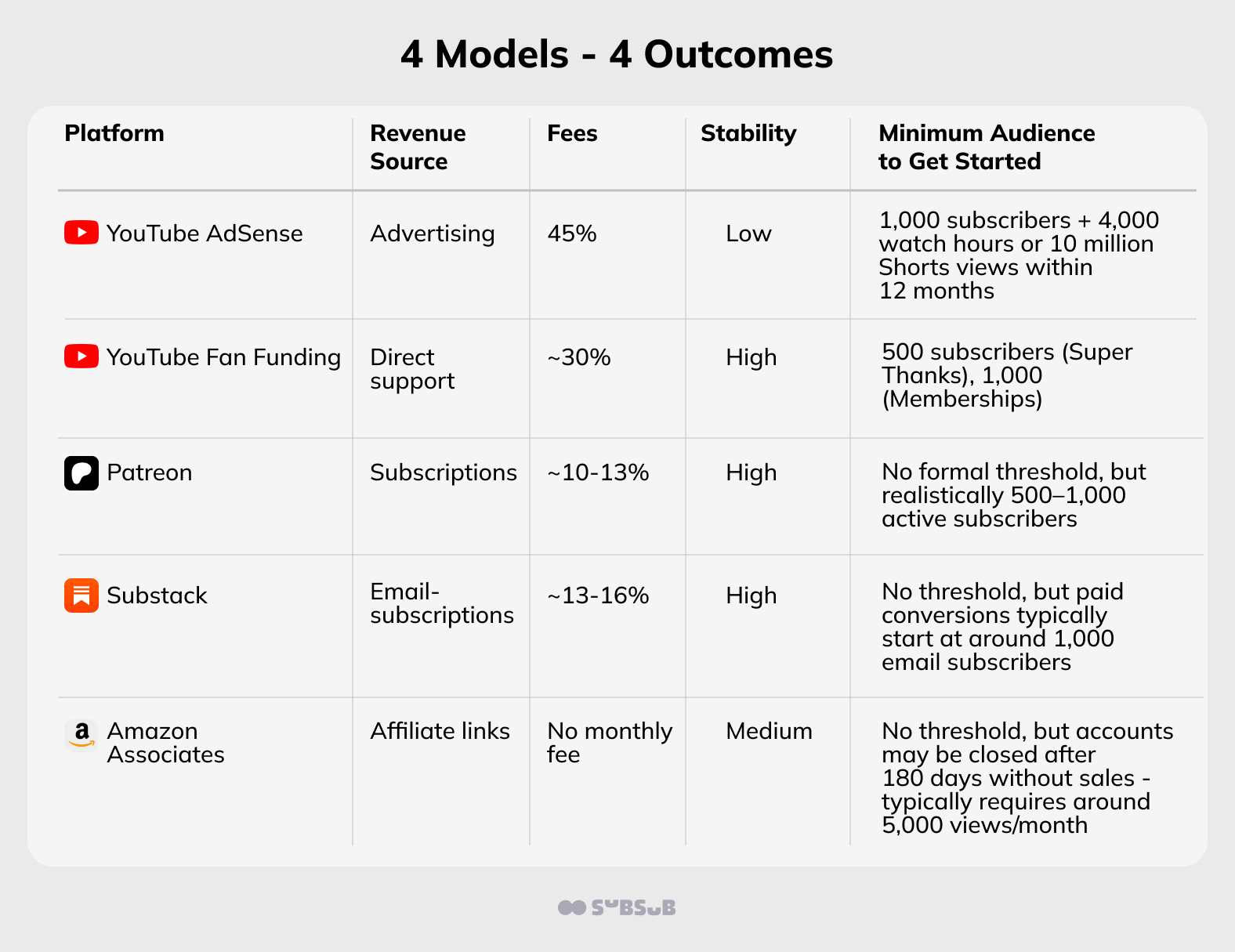
4 Models - 4 Different Outcomes
YouTube AdSense depends on views - the more videos and views a channel generates, the higher the potential revenue. However, ad revenue relies on stable traffic. That's why many creators focus on evergreen content that continues generating views for months or even years after publication. If you'd like to learn how to identify evergreen topics and optimize content for modern YouTube search, we recommend the article «YouTube SEO in 2026: The Complete Guide for Creators in the Age of Ask YouTube».
Patreon scales through subscriber count and average subscription value. There is a natural limit to how many people are willing to pay every month.
Substack grows through email list size and the conversion of free readers into paying subscribers. Its biggest advantage is direct ownership of the audience relationship.
Amazon Associates works passively - old videos can generate revenue for years. However, commission rates can change at any time.
The biggest mistake creators make is trying to use every monetization model at once. As a result, none of them reach their full potential because attention is spread too thin. It's more effective to introduce them gradually as the channel grows.
Checklist: Which Monetization Model Should You Choose?
Before launching Fan Funding, Patreon, Substack, or affiliate programs, answer these 10 questions.
1. Does your audience actively engage with your content?
Do your videos receive comments?
Do viewers return for new uploads?
Do people recognize you and participate in discussions?
If yes, consider testing Fan Funding or Patreon.
2. Is your audience willing to pay for additional value?
Do people ask for more content?
Do they frequently ask follow-up questions?
Do they want early access or exclusive materials?
If yes, Patreon, Memberships, or Substack may be a good fit.
3. Does your content include products, services, or tools?
Do you regularly mention software, equipment, or technology?
Do viewers ask, "What do you use?" or "Where can I buy this?"
If so, Amazon Associates or other affiliate programs may work well.
4. Does your audience consume written content?
Do people read your video descriptions?
Do they click links?
Do they subscribe to newsletters or Telegram channels?
If yes, consider testing Substack.
5. Do you livestream?
Do you host regular live streams?
Is your chat active during broadcasts?
If so, Fan Funding through Super Chat and Super Stickers can become an additional revenue source.
6. Are you willing to create bonus content consistently?
Do you have time for extra videos, posts, or newsletters?
Can you maintain that pace for several months?
Patreon and Substack require ongoing engagement with subscribers.
7. Do you have a way to reach your audience outside YouTube?
Do you have an email list?
Do you run a Telegram channel, Discord server, or another community?
If not, consider building additional communication channels.
8. How stable is your traffic?
Are your views consistent?
Or do they depend heavily on individual viral videos?
If traffic is unstable, it helps to have revenue sources that aren't tied to view counts.
9. What stage is your channel currently in?
Under 1,000 subscribers: focus on content and audience growth
After 1,000 subscribers: test Fan Funding
With an active community: consider Patreon or Substack
10. What is your primary goal?
Maximize revenue per subscriber?
Build stable monthly income?
Earn from product recommendations?
Reduce dependence on algorithms?
Even the best monetization strategy won't work if your content doesn't align with audience interests. At SubSub, we've built a tool that combines channel topics with current search trends and suggests video ideas at the intersection of your niche and real-time audience demand. Instead of spending hours researching manually, you'll get a curated list of topics your audience is already interested in and that naturally fit your channel.
100,000 subscribers are worthless if none of them click links, leave comments, or come back next week. On the other hand, 100 people who genuinely look forward to your content can generate more revenue than a million-subscriber channel with an indifferent audience.
Platforms pay for views.
People pay for trust.You can beat the algorithm once - create a viral video, predict a trend, or craft a compelling title. Trust takes years to build. And in the end, trust is what determines the true value of a channel.